



The Plenary issued the new Organic Statute of the Federal Telecommunications Institute (Press Release 35/2014)
The Plenary issued the new Organic Statute of the Federal Telecommunications Institute
- The new Organic Statue presents new model of organization with a multidisciplinary approach that deals with the powers and mandates that contemplates the implementation of Federal Telecommunications and Broadcasting Law and the Federal Antitrust Law
- To comply in due time and form with the Fourth Transitional Article of the Federal Telecommunications and Broadcasting Law which establishes the adequacy of the Regulation within the legal framework
- It incorporates a new convergent administrative order that responds to international best practices
On September 20, 2013 the Plenary of the Federal Telecommunications Institute (Instituto Federal de Telecomunicaciones, IFT) approved the first Organic Statute which responded to the need of having an administrative structure with specific powers so that this regulatory body is able to exercise its functions and to comply with constitutional mandates, providing for the issuance of a new regulation once the secondary legislation comes into force issued by the reform to the Constitution in the field of telecommunications.
In this respect, in compliance with the provisions of the Fourth Transitional article of the Federal Telecommunications and Broadcasting Law, today, in extraordinary session, IFT Plenary approved the issue of the Organic Statute, in order to adapt it to the mandates set out in the new legal framework.
The new Organic Statute incorporates a converging organizational model which lays down administrative units of competence to exercise their functions with a multidisciplinary approach that deals with the powers and mandates that contemplates the implementation of Federal Telecommunications and Broadcasting Law and the Federal Antitrust Law.
This converged structure includes the integration of substantive areas by specialized functions in which each will serve the corresponding issues of both telecommunications and broadcasting.
For the design and creation of the Organic Statute international best practices were taken into account, based on a compared survey between over 10 regulators from various parts of the world, which is an administrative ordering oriented to the efficiency in the implementation of the procedures carried out by the Institute.
It highlights the creation of the IFT Center for Studies, which will develop research, studies and analyses in the fields of telecommunications, broadcasting and economic competition in these sectors, to contribute to the performance of the functions of the Plenary and generate documents that are useful to industry, academia, and society in general.
Before the important task of protecting the rights of the users of telecommunications services, the General Coordination of User Policy is created, whose objective is to design and implement policies and guidelines to ensure protection of the population that receives and hires various services, among others.
On another note, to comply with legal mandates in the field of media and audiovisual policy, the approved General Regulation incorporates the Media and Audiovisual Content Unit, which will be in charge of designing and planning such policies to promote free access to diverse information, freedom of expression and the protection of the rights of audiences, among others.
Furthermore, the Radio Spectrum Unit main function will be the management of this resource, while the design of regulatory policy will remain with the Regulatory Policy Unit.
In response to the IFT objective to have greater participation and advocacy at the international level, the new organizational model will have a General Coordination of International Affairs that will act as the Institute liaison with authorities and international agencies for the execution of projects and follow-up to cooperation agreements, among others.
The General Coordination of Strategic Planning and Regulatory Improvement are also created to give full compliance to the obligations set out in the Federal Telecommunications and Broadcasting Law.
With the issue of the General Regulation, not only compliance in due time and form is provided to the obligation of harmonizing this system with the new legal provisions, but also creates a new institutional design which will allow this body to regulate the telecommunications and broadcasting sectors in a modern and efficient manner, as well as the protection of the rights of users of services and stakeholders.
Documentos para descargar
Temas relacionados
Invitación a cuando menos tres personas
Convocatoria y Anexo Núm. 1 de la Invitación a cuando menos tres personas de carácter nacional y electrónica Núm. IA-043D00001-N194-2014, para la adjudicación del Contrato Abierto, relativo a la contratación del “Servicio consistente en la aplicación y análisis de encuestas para identificar los niveles de satisfacción de los usuarios en los servicios de telecomunicaciones”
Convocatoria y Anexo Núm. 1 de la Invitación a cuando menos tres personas Núm. IA-043D00001-N192-2014, para la adjudicación del Contrato, relativo a la contratación de los “Servicio de Asesoría Especializada en materia de Accesibilidad”
Convocatoria y Anexo Núm. 1 de la Invitación a cuando menos tres personas Núm. IA-043D00001-N189-2014 (Segunda Convocatoria), para la adjudicación del Contrato Abierto, relativo a la contratación del “Servicio integral en medio complementario mediante la reproducción, impresión, ensobretado y entrega de correo directo a través de correos de México, del Programa para la conclusión de la transmisión de señales analógicas de televisión” Convocatoria Anexo Número 1
Convocatoria y Anexo Núm. 1 de la Invitación a cuando menos tres personas Núm. IA-043D00001-N188-2014 (Segunda Convocatoria), para la adjudicación del Contrato Abierto, relativo a la contratación de los “Servicios para la realización de la auditoría con cifras al 31 de diciembre de 2014 en materia financiera-presupuestaria”
Convocatoria y Anexo Núm. 1 de la Invitación a cuando menos tres personas Núm. IA-043D00001-N187-2014, para la adjudicación del Contrato, relativo a la contratación de los “Servicios de desarrollo informáticos para las aplicaciones móviles y web de consulta del Cuadro Nacional de Atribución de Frecuencias (CNAF)”
Convocatoria y Anexo Núm. 1 de la Invitación a cuando menos tres personas Núm. IA-043D00001-N186-2014, para la adjudicación del Contrato Abierto, relativo a la contratación del “Servicio integral en medio complementario mediante la reproducción, impresión, ensobretado y entrega de correo directo a través de correos de México, del Programa para la conclusión de la transmisión de señales analógicas de televisión”
Anexo Número 1
Convocatoria y Anexo Núm. 1 de la Invitación a cuando menos tres personas Núm. IA-043D00001-N185-2014, para la adjudicación del Contrato, relativo a la contratación de los “Servicio de Jardinería”
Convocatoria y Anexo Núm. 1 de la Invitación a cuando menos tres personas Núm. IA-043D00001-N184-2014, para la adjudicación del Contrato Abierto, relativo a la contratación de los “Servicios para la realización de la auditoría con cifras al 31 de diciembre de 2014 en materia financiera-presupuestaria”
Temas relacionados
The Plenary resolves on the terms and conditions of the first infrastructure public offering of the Preponderant Economic Agent members in the broadcasting sector (Press Release 34/2014)
The Plenary resolves on the terms and conditions of the first infrastructure public offering of the preponderant economic agent members in the broadcasting sector
- In a period of 15 calendar days after being notified, the companies must submit an Offer that complies with the requirements established in the measures imposed for infrastructure matters
- IFT issued three Technical Provisions which contain the minimum specifications for the installation and operation of broadcasting services (AM, FM and television), which will avoid falling into a regulatory vacuum with the loss of validity of the corresponding official Mexican Standards in the next few days
- The Institute will initiate a public consultation within the following 90 calendar days, in order to conduct a comprehensive review of technical provisions that regulate the different broadcasting services
On March 6th of this year, the Plenary of the Federal Telecommunications Institute (Instituto Federal de Telecomunicaciones, IFT) adopted the resolution by means of which it determined the economic interest group headed by Grupo Televisa. S.A.B., as preponderant economic agent in the broadcasting sector, and imposed specific measures, in accordance with the provisions of the Eighth transitory article of the decree of constitutional reform in the telecommunications field.
As part of these measures, it was established that the Preponderant Economic Agent must submit for the Institute's approval the first Public Offer of Infrastructure (POI), i.e., the set of conditions and information which obligates to allow access to and use of passive infrastructure to broadcast television service concessionaires who request it.
The passive infrastructure refers to non-electronic items at the service of transmitting plants, and Television Broadcasting Concession Service networks that include, among others, the right of way, conduits, masts, trenches, towers, poles, equipment facilities and related feeds, security, auxiliary equipment, sites, properties, physical spaces (except studios), ducts and pipes, as well as energy sources and air conditioning systems.
After the Institute conducted an analysis of the information submitted by the Preponderant Economic Agent in the broadcasting sector, the IFT Plenary ruled, in an extraordinary session held yesterday, the terms and conditions which shall contain the POI of each of the members of the Preponderant Economic Agent.
In this respect, considered that the information received does not provide all the elements that these companies should include in the POI, they were required to, within a period of 15 calendar days after being notified, to submit to the Institute's consideration an offer that meets the requirements of infrastructure issues.
On another note, the Plenary issued three Technical Provisions which contain the specifications for the installation and operation of broadcasting services:
a) Technical Provision IFT-001-2014: Specifications and Minimum Requirements for the Installation and Operation of Sound Broadcast Stations in Amplitude Modulation, which shall enter into force on August 29th this year.
b) Technical Provision IFT-002-2014: Specifications and Minimum Requirements for the Installation and Operation of Sound Broadcast Stations in Frequency Modulation, which shall enter into force on September 1st this year.
c) Technical Provision IFT-003-2014: Specifications and Minimum Requirements for the Installation and Operation of Analog Television Broadcast Stations (VHF and UHF bands), which shall enter into force on September 2nd this year.
Notwithstanding that the Federal Telecommunications and Broadcasting Law establishes it is the IFT obligation to carry out public consultations for the issuance and amendment of rules, guidelines or administrative provisions of a general nature, due to the proximity of the conclusion of the entry into force of the Official Mexican Standards (NOM-01-SCT1-1993; NOM-02-SCT1-1993; Nom-03-SCT1-1993), which establish the technical specifications for the installation and operation of stations for the three broadcasting services mentioned in equal order, the issuance of these Technical Provisions is required and thus to avoid a regulatory vacuum that would cause negative effects on users and the industry.
Thus the IFT Plenary, in use of its powers to issue general administrative enforcement to regulate technical aspects regarding the installation and operation of radio stations, in accordance with articles 6 and 28 of the Political Constitution of the United Mexican States and articles 1, 2, 7 and 15 of the Federal Telecommunications and Broadcasting Law, determined the issuance of those provisions which shall remain in force for one year from the following day of their entry into force.
However, in accordance with the principles of transparency and citizen participation, the Institute will start a public consultation in the following 90 calendar days in order to make a deep and comprehensive revision of the Technical Provisions that will be applied at the time instead of the approved ones today that are only considered specifications and minimum requirements for the installation and operation of broadcasting stations.
The Federal Telecommunications Institute Plenary reviews the tender proposals of wholesale services submitted by TELMEX, TELCEL and TELNOR (Press Release 33/2014)
The Federal Telecommunications Institute Plenary reviews the tender proposals of wholesale services submitted by TELMEX, TELCEL and TELNOR
- It determines to require various modifications from the Preponderant Economic Agent in order that the wholesale supply allows the provision of telecommunications services in fair conditions of competition
- Once the agreements are notified, the Preponderant Economic Agent will have 20 working days to meet the Institute requirements and resubmit the Tenders for consideration
As reported in a timely manner, on March 6th this year, the Federal Telecommunications Institute (Instituto Federal de Telecomunicaciones, IFT) Plenary approved the resolution which determined the preponderant economic agent for the telecommunications sector (Telmex, Telnor and Telcel) and imposed specific measures in accordance with the provisions of the Eighth Transitory Article of the decree for Constitutional Reform in Telecommunications matters.
Among such measures it was established that Telmex, Telnor and Telcel must submit, for the approval of the Institute, Reference Offers for the following wholesale services:
- Lease of dedicated links
- Shared Access and Use of the Passive Infrastructure in fixed networks
- Shared Access and Use of the Passive Infrastructure in mobile networks
- Virtual Mobile Operators
- Visiting Users Wholesale Service
Following a thorough analysis of the Tenders presented to the Institute by Telmex, Telnor and Telcel, the Plenary resolved today in a special session, to request various modifications from the Preponderant Economic Agent in order that the wholesale supply allows the provision of telecommunications services in fair conditions of competition, in accordance with the objectives determined by the Institute.
Once the agreements are notified to the Preponderant Economic Agent, it will have 20 working days to meet the requirements of the Institute and resubmit the Reference Offers for consideration, in order for the Institute to authorize them, or modify them under their terms and conditions when they do not conform to the measures or do not provide conditions that promote competition in the sector.
Documentos para descargar
Temas relacionados
The IFT Plenary submits to Public Consultation the procedure which telecommunications services 'permisionarios' licensees and qualifiers must fulfil for the electronic registration of service rates that they will offer to the users (Press Release 32/2014)
The IFT Plenary submits to Public Consultation the procedure which telecommunications services 'permisionarios' licensees and qualifiers must fulfil for the electronic registration of service rates that they will offer to the users
- The public consultation of the registration electronic mechanism of rates will allow the strengthening of the Institute decision-making.
- There will be an electronic system for the rates registration which will be accessible to users so that they can learn about operator services and promotions.
- IFT agrees to impose sanctions and declare the loss in benefit of the nation, assets intended for the operation of seven FM radio stations which do not have permission or concession to operate.
- IFT determines 31 radio stations in Amplitude Modulation (AM), which at the time were authorized to change to FM frequency and which must continue broadcasting simultaneously in AM.
- Resolves three interconnection disagreements between operators of fixed and mobile telecommunications networks.
- Appoints Juan José Crispín Borbolla as the Plenary Technical Secretary.
In ordinary session, the Federal Telecommunications Institute (Instituto Federal de Telecomunicaciones, IFT) Plenary agreed to submit to public consultation the "Draft Agreement which establishes the procedure for the submission of the electronic application for registration fees to users that must be complied by telecommunications services concessionaires, under relief of the Federal Telecommunications and Broadcasting Law” for a period of ten working days, counting from its publication on the IFT website.
In accordance with article 205 of the Federal Telecommunications and Broadcasting Law, telecommunications service concessionaires must submit an electronic application for registration of its user rates, prior to its entry into force, so the Institute shall establish an electronic mechanism so that the prices of the services may be applied from the date of the respective application.
Public consultation merits transparency and promotes citizen participation in the general provisions issuance process arising from the IFT. With the results obtained, the Institute may implement an electronic mechanism for efficient, robust and clear rates registration which will eliminate artificial barriers for the immediate adoption of attractive and competitive commercial schemes for the various users of telecommunications services.
Furthermore, the Plenary determined sanctions and declare the loss in benefit of the nation of assets intended for the operation of seven broadcasting stations transmitting on the FM band without corresponding concession or permission.
In all cases, IFT made assurance preventive visits at the addresses that operated the stations. In strict adherence to the law, the administrative procedure was satisfied and found the non-existence of concession titles or permits to accredit the legal operation of these frequencies. As a result, the IFT Plenary determined, based on articles 101, fraction XXIII, 103, 104 bis and 106 of the Federal Radio and Television Law, to impose sanctions and declare the loss in benefit of the nation, the assets intended for the operation of stations in the following frequencies and locations:
FREQUENCY | LOCALITY/STATE
|
103.1 MHz | Atlixco, Puebla |
106.3 MHz | Atlixco, Puebla |
88.9 MHz | Cosoloeacaque, Veracruz |
107.3 MHz | Huatusco, Veracruz |
91.1 MHz | Nopalucan, Puebla |
102.7 MHz | San Pedro Benito Juárez, Puebla |
104.3 MHz | San Pedro Mártir, Veracruz |
Likewise, the Plenary determined that 31 AM radio stations, which were authorized to change to the FM frequency, will continue operating simultaneously, until the Institute determines that the provision of the broadcasting service in all the populations of the area covered by these stations is guaranteed based on technical studies conducted by the Radio and Television Systems Unit.
Thus, various communities in the country that only have AM coverage will remain connected through this service, based on provisions of the Sixth item of the "Agreement which establishes the requirements to carry out the change of authorized frequencies to provide the radio service operating in the band of modulated amplitude in order to optimize the use, leveraging and exploitation of an asset in the public domain in transition to digital radio", published in the Federal Official Gazette on September 15th, 2008.
In telecommunications matters, the Plenary determined the non-agreed terms of interconnection conditions between network operators of fixed and mobile telecommunications for termination services in the "calling party pays" scheme, applicable for the period of January 1st to December 31st, 2012. These decisions established the following:
1. Megacable Comunicaciones de México must pay a $0.3214 pesos fee per interconnection minute to Operadora Unefon, SOS Telecommunicaciones, Iusacell PCS de México, Iusacell PCS and Comunicaciones Celulares de Occidente.
2. Megacable Comunicaciones de México must pay a $0.3214 pesos fee per interconnection minute to Pegaso PCS.
3. Pegaso PCS must pay a fee of 0.02432 pesos per minute to Cablevision, Bestphone, Operbes, Cablemás Telecomunicaciones and Cable and Cable y Comunicación de Campeche. While these companies with fixed networks must pay a fee of $0.3214 pesos per interconnection minute to Pegaso PCS.
At the session, by unanimous vote, the highest organ of the IFT government Commissioners appointed Juan José Crispín Borbolla as Technical Secretary of the Plenary, as provided in article 17, section III of the Federal Telecommunications and Broadcasting Law.
Documentos para descargar
Temas relacionados
The IFT Plenary resolves 80 procedures submitted by concessionaires and 'permisionarios' (licensees) of telecommunications and broadcasting services (Press Release 31/2014)
The IFT Plenary resolves 80 procedures submitted by concessionaires and 'permisionarios' 1 licensees of telecommunications and broadcasting services
- With these agreements the IFT advances in pending industry procedures
- The IFT grants 7 permits to telecommunications distributors to establish and operate
- It approves 14 requests for the extension of public telecommunications networks concessions validity
- IFT resolves to grant 35 endorsements for the use, exploitation and operation of radio stations in various localities of the country
Today, the Plenary of the Federal Telecommunications Institute (Instituto Federal de Telecomunicaciones, IFT) approved, in extraordinary session, 80 matters relating to endorsements of radio and television stations, the issuance of various titles of concession and grants of extension of concessions of public telecommunications networks, among others.
It highlights the grants of seven permits to establish and operate telecommunications services distributors, which promotes the entry of new suppliers and with it a greater diversity in the supply of local fixed and mobile telephony services; national and international long distance and data transmission, as well as restricted television and audio.
The concessions are companies that resell the services referred to by the use of the capacity of a licensee's public telecommunications networks. On this occasion, the permissions granted by the Plenary correspond to Comtelsat, S.A. de C.V.; Inaecom, S.A.P.I de C.V.: Kubo Cel. S.A.P.I. de C.V.; Matriz Murano, S.A. de C.V.: Sitm S.A. de C.V. and GBR TEL, S.A. de C.V.
Regarding extensions of concession titles in telecommunications, 14 requests from concessionaires of public telecommunications networks in various localities of the country were adopted. IFT also approved an extension of the validity of title to a concessionaire who exploits emission and reception rights of signals of frequencies associated with foreign satellite systems operating in the national territory.
Also, the Plenary decided to grant two concession titles for the installation, operation and exploitation of public telecommunications networks in Mexico City and Chiapas, respectively, and agreed to grant a concession to exploit the rights of emission and reception of frequency bands signals associated with foreign satellite systems to cover and provide services in the national territory.
The broadcasting sector decided to grant 35 endorsements for the use, leveraging and exploitation of concession holders for radio stations in various locations in 19 states across the country, which guarantees the continuity of the service in the areas in which the concessionaires operate and significantly advances in the relief of the pending proceedings in this matter.
Likewise, the Plenary approved the endorsement of 19 permits to television stations, in favor of Governments of the States of Sonora, Michoacán and Nuevo León. The endorsement of these permits will facilitate the move of the stations to digital terrestrial television in the country.
1 According to the Federal Official Gazette (DOF), any natural or legal person who has the corresponding permission to provide Broadcasting Services, this term is translated herein as “licensee".
Documentos para descargar
Temas relacionados
The IFT Plenary approves the call to tender and bases of two geostationary orbital positions (Press Release 30/2014)
The IFT Plenary approves the call to tender and bases of two geostationary orbital positions
- It will be the first allocation of orbital positions in the country since 2005
- Those interested in participating in this tender must obtain favorable opinion from the Institute with regard to economic competition
- IFT agrees to submit for public consultation the project to adapt the Policy for the Transition to Digital Terrestrial Television between July 18th and August 8th
- IFT issues the Regulatory Provisions to which the procedures are subject that the Institute resolves in the field of economic competition, derived from the Federal Antitrust Law
- The President Commissioner approves to turn antitrust issues that apply to other members of the Plenary, on a rotational basis, to serve as Speaker Commissioners
During an extraordinary session held yesterday, the Plenary of the Federal Telecommunications Institute (Instituto Federal de Telecomunicaciones, IFT) approved the Call to Tender and Bases of the public bidding process for granting concessions to occupy the geostationary 113 ° West and 116.8 ° West orbital positions and use the associated extended C and Ku frequency bands, as well as the emission rights and reception signals for the provision of satellite capacity for the fixed-satellite service.
The orbital positions to be tendered have coverage in the national territory, and are for commercial satellite services, such as dedicated data links, DTH and links between corporate.
Those interested in participating in this tender must obtain favorable opinion from the IFT in economic competition, which must be presented in accordance with the corresponding instructions, which also was approved yesterday by the Plenary.
The Bases, Appendices and Annexes, as well as the instructions will be available for consultation and free download on the IFT website from July 18th this year.
With this bidding process, IFT promotes the participation of more competitors in the satellite market, which will result in greater investment, technological development, and better quality and price in the provision of services.
Additionally, in order to adapt the administrative arrangements with respect to the transition to Digital Terrestrial Television (Televisión Digital Terrestre, TDT) to be consistent with the Nineteenth transitory article of the Decree which is issued by the Federal Telecommunications and Broadcasting Law, published on July 14th this year in the Federal Official Gazette, the IFT Plenary resolved to submit for public consultation the draft entitled "Policy for the Transition to Digital Terrestrial Television", prepared by the Radio and Television Systems Unit.
This exercise will allow to know the comments, proposals and opinions of stakeholders and society in general about the content of the draft Policy, which will be evaluated by the Institute and, where appropriate, incorporated into the document to strengthen it. The Institute will publish on its website a document that addresses in general the comments, views and proposals received within the period of consultation, specifying which ones resulted in adjustments to the draft Policy, which in turn is subject to consideration by the Plenary.
The public consultation will take place in the period between July 18th and August 8th of 2014, and both the draft policy and a format for the submission of contributions will be available to interested parties, which will be received, in writing, through the IFT webpage at any time during the period of consultation, or at the Filing Office of the Institute on July 18th, as well as in the period covered from August 4th to 8th this year.
Once the public consultation closes, the Radio and Television Systems Unit, within the next 10 working days, shall submit the draft deemed result of this process to consideration of the Plenary, to be adopted and published the "Policy for the Transition to Digital Terrestrial Television" in the Official Gazette of the Federation (Diario Oficial de la Federación, DOF).
Also in the broadcasting field, in strict compliance to record number R.A. 21/2014, from relief trial 44/2014 promoted by Luis Carlos Mendiola Codina, the IFT Plenary voided the provisions the resolution adopted in its 1st Extraordinary Session, held on November 8th, 2013, as well as the consequences arising from it.
Additionally, upon the entry into force of the new Federal Antitrust Law on July 7th, the Rules derived from the previous norm are ineffective until this has been repealed and, in use of the powers conferred by article 28 of the Constitution and article 12 of this Law, the IFT Plenary agreed to issue the Regulatory Provisions to which the procedures will be subject that this regulator resolves with regard to economic competition.
With these provisions, the IFT offers legal certainty to economic operators regulated given that this legal instrument is necessary to achieve an effective implementation of the procedures provided for in the Federal Antitrust Law and that this regulatory body effectively meets its function of authority in the field of economic competition in the broadcasting and telecommunications sectors.
The Federal Antitrust Law, while envisaging to carry out public consultation for the issuance of these Provisions, also includes the possibility of exempting from it in the case of situations that so require.
For this reason, it is necessary to issue the Regulatory Provisions, in order to have the legal tool to effectively fulfill its role of authority in the field of economic competition in the broadcasting and telecommunications sectors and exercise the incremental powers not provided for in the repealed law.
In addition, in its commitment to transparency and participation of the citizens, the Institute will shortly carry out public consultation on the Regulatory Provisions on economic competition, in order to receive the views and comments of stakeholders that will allow to strengthen the document and issue a new one in a period not exceeding six months from the entry into force of the Federal Antitrust Law, which will occur on January 7th, 2015.
The Plenary also approved that the President Commissioner, in exercise of his powers, turn the issues of economic competition in the assumptions that thus correspond to other Commissioners, which will act as Speaker Commissioners, on a rotational basis, in accordance with articles 83 fraction VI and 106 fraction IV of the Federal Antitrust Law. The strict order will be the responsibility of, as stipulated by law, the appointment of Commissioners, and that should be understood in accordance with the period of their appointment, so it shall be in the following form: Luis Fernando Borjón Figueroa, followed by Ernesto Estrada González, Adriana Sofía Labardini Inzunza, María Elena Estavillo Flores, Mario Germán Fromow Rangel and Adolfo Cuevas Teja, starting equally and again, once each cycle terminates.
Documentos para descargar
Temas relacionados
The IFT Plenary approves the format for text messages that TELCEL will send to its users when they purchase airtime credit (Press Release 29/2014)
The IFT Plenary approves the format for text messages that TELCEL will send to its users when they purchase airtime credit
- Each time that a Telcel prepaid time user purchases airtime, the user will receive a text message with the deposited amount, another with the accumulated balance available at that time and a third with the basic applicable rates
- The Institute determines non agreed interconnection conditions of various concessionaires of public telecommunications networks
- IFT resolves that 27 AM radio stations will continue to transmit in this band in order to ensure the continuity of the radio service in the towns where they operate
- The Quarterly Report of Activities for the period April - June is presented
As part of the obligations imposed on preponderant economic agents in the telecommunications sector, the Federal Telecommunications Institute (Instituto Federal de Telecomunicaciones, IFT) established user protective measures, including delivery of clear information to subscribers about contracted services fees and products billed by these companies.
With this respect, at its ordinary session held yesterday, the IFT Plenary approved the format of text messages that Telcel will send users on prepaid or postpaid mixed schemes when they purchase airtime, in accordance with the provisions of the forty-third provision of measures applicable to this preponderant economic agent.
Therefore, the short messages that Telcel will send, and which will be free to the user, will consist of 1) the amount paid; 2) the accumulated balance including the payment, and 3) the basic rates applicable to the prepaid scheme that the user has contracted, both for the local service, long distance, SMS and Internet megabytes.
The obligation to deliver the short messages with information is of great importance for prepaid subscribers so they have the information required on phone spending, given that users receiving the mobile service in this scheme do not have a monthly bill they can review for the use or the rates paid for them, or if there were any change in prices.
The company must comply with this implementation over no later than 60 days after being notified of this resolution.
In addition, Telcel will be required to present the short message format corresponding to the information of the international roaming rate which it will send to users when they purchase airtime abroad.
Additionally, six resolutions to resolve disagreements on interconnection between concessionaires of public telecommunications networks were emitted in this session.
Two of these resolutions refer to the termination of switched services for mobile users under the "calling party pays" scheme: 1) NII Digital, S. de R.L. de C.V. and Comunicaciones Celulares de Occidente, S.A. de C.V., Sistemas Telefónicos Portátiles Celulares, S.A. de C.V., Telecomunicaciones del Golfo, S.A. de C.V., SOS Telecomunicaciones, S.A. de C.V., Portatel del Sureste, S.A. de C.V., Iusacell PCS, S.A. de C.V., Iusacell PCS de México, S.A. de C.V. and Operadora Unefon, S.A. de C.V., and 2) NII Digital, S. de R.L. de C.V. with Pegaso PCS, S.A. de C.V. In both cases, an interconnection rate of $0.3214 pesos per minute was approved, applicable from January 1st to December 31st, 2012, in which companies must pay in a reciprocal manner was adopted.
Similarly, the Plenary determined the non-agreed interconnection conditions between Operbes, S.A. de C.V., Bestphone, S.A. de C.V., Cablevisión, S.A. de C.V., Cablemás Telecomunicaciones, S.A. de C.V., Cable y Comunicación de Campeche, S. A. de C.V., and Grupo Iusacell companies, resolving that the rate for termination services under the "calling party pays" scheme, that mobile networking companies must pay will be $0.3214 pesos per minute, applicable from January 1st to December 31st, 2012. Meanwhile, the interconnection rate which Grupo Iusacell companies will pay to the referred counterpart for the same period is $0.02432 pesos per minute, for switched termination services of fixed users.
In addition, three interconnection disagreements were resolved separately between Televisión Internacional, S.A. de C.V. (TVI) with the following concessionaires 1) Grupo Iusacell companies; 2) Pegaso PCS and 3) Radiomóvil Dipsa, S.A. de C.V. It was determined for all three cases that TVI must pay a fee of $0.3214 pesos per minute, valid from January 1st to December 31st, 2012 to the above mentioned concessionaires of mobile and these, in turn, will have to pay a fee of $0.02432 pesos per minute for switched termination services to fixed TVI users.
In the broadcasting field, the Plenary determined 27 AM radio stations, associated with changes to the FM frequency, which will continue operating in the AM band, until the Institute determines that the provision of the broadcasting service in all the populations of the area covered by these stations is guaranteed based on technical studies conducted by the Radio and Television Systems Unit.
This resolution achieves that small communities in the country that only have AM coverage continue communicating through radio, based on provisions of the Sixth item of the "Agreement which establishes the requirements to carry out the change of authorized frequencies to provide the radio service and operating in the amplitude modulated band, in order to optimize the use, application and exploitation of a public domain asset in the transition to digital radio", published in the Federal Official Gazette on September 15th, 2008.
On other issues, the IFT Plenary resolved to issue 24 permission titles subject to the endorsement for the use of a broadcasting frequency for official purposes through different radio stations in the frequency modulated band, of which 21 are for the Government of the state of Sonora, two for Tabasco and one for Puebla.
Likewise, the Institute determined to grant three titles of permission subject to endorsement to use a frequency modulated sound broadcast with cultural purposes in the FM band, two of which are for universities of Colima and Guanajuato, respectively, and another one for an individual.
The IFT Plenary also presented its Quarterly Report of Activities for the period April - June, which will be available for consultation on the Institute's website in the coming days. This document realizes the follow-up to the "180 days Schedule", of institutional projects and various actions associated with the coordination projects with the Federal Executive.
Finally, the Plenary approved modification to the Organic Statute, to comply with the provisions of the new Federal Law of Economic Competition.
Documentos para descargar
Temas relacionados
The IFT decides over 65 processes in telecommunications and broadcasting matters (Press Release 28/2014)
The IFT Plenary decides over 65 processes in telecommunications and broadcasting matters
- Issues a favorable opinion so Telcordia may be the Database Administrator for numeral portability purposes
- Decided to grant the permit certificate to use a State of Chiapas indigenous radio station for cultural purposes
- It approves the granting of four new concession certificates and an equal number of extension of concessions to install, operate and exploit a public telecommunications network in different locations of the country
- It decides on the issuance of 24 concession sound radio stations certificates, subject to approval
In an ordinary session, the Federal Telecommunications Institute (Instituto Federal de Telecomunicaciones, IFT) Plenary, decided over different telecommunications and radio matters, amongst which we highlight the granting of concessions for public fixed telecommunications networks, the extensions of concession certificates and the approval of operations of different radio stations, inter alia.
In sum, approximately 65 processes were processed, whereby the IFT provides legal certainty so that concessionaires may be able to plan their operations, guarantees the continuity of the services in different locations and promotes the participation of a bigger number of providers in the markets, for the users benefit.
Amongst the matters discussed, the Plenary issued a favorable opinion on the decision reached by general consent in the Technical Committee of Number Portability, so that Telcordia continues as the Database Administrator for the number portability process. This company has provided this service since July of 2008, when the right for the users to change of operator became effective, all the while keeping their same telephone number. The first agreement will conclude in July of the current year, and in this month it will renew for a period of three years.
Likewise, the Plenary was informed about five requests to extend the concession certificates of public telecommunications networks that offer television services by subscription in different locations in the country, and decided to reject them since they do not fulfill the applicable legal requirements. The information on the operators and the geographic zone where they provide their services will be published in due course on the IFT Internet page, so the users may adopt the pertinent measures.
In addition, it was decided to grant extensions to four concession certificates to install, operate and exploit a public telecommunications network with coverage in different locations of the country for a 10 years term.
Concessionaire | Location |
1. C. René Francisco Bermúdez Molina | Villa Ávila Camacho (La ceiba), municipality of Xicotepec, Puebla |
2. Televisión por Cable Toniná. S.A. de C.V. | Ocosingo, municipality of Ocosingo, Chiapas |
3. Cable del Valle de Toluca S.A de C.V. | Ixhuatlán de Madero and Llano En medio, municipality of Ixhuatlán de Madero, Veracruz |
4. Varivisión de Baja California S.A de C.V. | Different locations of the State of Baja California |
Likewise, the Institute decided to grant four concession certificates to install, operate and exploit a public telecommunications network with coverage in different cities of the country.
Concessionaire | Location |
1. Todo Mundo Telecomunicaciones S.A de C.V. | Ciudad Apodaca, municipality of Apodaca, Nuevo León |
2. Sistemas de Transporte de Datos S. de R.L. de C.V. | Tijuana, Baja California |
3. UC Telecomunicaciones S.A.P.I. de C.V. | States of México, Hidalgo, Nuevo León, Jalisco, Tamaulipas, Veracruz and Federal District |
4. Servicios Caseteros S.A.P.I. de C.V. | State of México and Federal District |
In broadcasting matters, the Plenary also decided to grant a permit certificate to use an FM radio frequency to be used in cultural purposes to provide sound broadcasting services in favor of Comunicación Educativa y Cultural BAT´S IL K´OP, A.C in Bachajón, municipality of Chilón, Chiapas.
From the analysis conducted to the request, the IFT Plenary considers that it was submitted and formed according to the requirements set forth in Articles 17–E and 20 of the Federal Law of Radio and Television, and other applicable legal provisions.
As part of the justification of the project of decision, it was considered that in the location of Bachajón no radio or television stations with permits or concessions have been installed, and thus, by granting the permit certificate, the applicant may establish a mean that allows the integration of the communities through the construction and communication lines extension. Furthermore, the applicant states as a purpose, to establish a communication process that could be used as platform to hold talks, share needs and strengthen the indigenous culture in the zone, which has 118 thousand 180 inhabitants, of which 95.3 percent are in circumstances of poverty.
According to the information provided by the selfsame applicant, 86% of the population speaks an indigenous language and 46% does not speak Spanish, and thus, it is deemed that it fulfills one of the purposes submitted in the project, consisting in aiding or assisting the vulnerable sectors of indigenous communities of the northern forest region of the State of Chiapas.
Through its programming, the radio station will procure to provide a communication and information service significant for the region, in terms of the Tzeltal indigenous communities, which implies to generate contents that actually represent the cultural identity through an indigenous worldview.
In the session held today, the Plenary decided to issue 24 concession certificates subject to being approved to exploit radio frequency stations:
Concessionaire | Frequency/Band
| Location |
1. Radio XHVC-FM S.A. de C.V. | 102.5 MHz in FM (XHVC-FM) | Puebla, Puebla |
2. María Guadalupe Espinoza Pedrín | 97.5 MHz in FM (XHVSD-FM) | Ciudad Constitución, Baja California Sur |
3. XEEIAM S.A. de C.V. | 93.1 MHz in FM (XHEI-FM) | Los Paisanos, San Luis Potosí |
4. Radio Auditorio S.A. de C.V. | 660 kHz in AM (XEFZ-FM) | San Nicolás de los Garza, Nuevo León |
5. XHCU S.A. de C.V. | 104.5 MHz in FM (XHCU-FM) | Cuautla, Morelos |
6. Fórmula Radiofónica S.A. de C.V. | 103.9 MHz in FM (XHMTSFM) | Tampico, Tamaulipas |
7. Radio XEIN la Voz del Valle S.A. de C.V. | 89.9 MHz in FM (XHEIN-FM) | Cintalapa de Figueroa, Chiapas |
8. Triple Q. Radio S.A. de C.V. | 89.9 MHZ in FM (XHQQQ-FM) | Villahermosa, Tabasco |
9. Cosmorradial S.A. de C.V. | 106.1 MHz in FM (XHLTZ-FM) | Aguascalientes, Aguascalientes |
10. XEIK S.A. de C.V. | 96.7 MHZ in FM (XHZG-FM) | Piedras Negras, Coahuila |
11. Alberto Miguel Márquez Rodríguez | 101.7 MHz in FM (XHGB-FM) | Oaxaca de Juárez, Oaxaca |
12. Radiodifusora XETAP-AM S.A. de C.V. | 98.7 in FM (XHTAP-FM) | Tapachula, Chiapas |
13. Radio Mil del Sur S.A. de C.V. | 1000 kHz i n AM. Additional frequency in 92.1 MHz i n FM (XHMYL-FM) | Mérida, Yucatán |
14. Difusoras de Chihuahua S.A. | 1360 KHz in AM. Additional frequency in 88.5 MHz in FM (XHDI-FM) | Chihuahua, Chihuahua |
15. Radio Progreso de Yucatán S.A. de C.V. | 96.9 MHz in FM (XHUL-FM) | Mérida, Yucatán |
16. José Luis Martínez Sánchez | 91.7 MHz in FM (XHIY-FM) | Río Verde, San Luis Potosí |
17. Grupo Radiodigital Siglo XXI S.A. de C.V. | 101.3 MHz in FM (XHYK-FM) | Conkal, Yucatán |
18. Centro de Frecuencia Modulada S.A. de C.V. |
96.9 MHz in FM (XHOD-FM) | San Luis Potosí, San Luis Potosí |
19. Trigio Javier Pérez de Anda | 93.9 MHz in FM (XHHY-FM) | Querétaro, Querétaro |
20. Alberto Elorza García | 99.3 MHz in FM (XHAFA-FM) | Nanchital, Veracruz |
21. Radio Calvillo S.A. de C.V. | 100.9 MHz in FM (XHCAA-FM) | Aguascalientes, Aguascalientes |
22. Alejandro Rodríguez Morán | 105.1 MHz in FM (XHYD-FM) | Francisco I. Madero, Coahuila |
23. XHTGZ | 96.1 MHz in FM (XHTGZ-FM) | Tuxtla Gutiérrez, Chiapas |
24. Radio Vallarta S.A. de C.V. | 740 KHz in AM. Additional frequency in 92.7 MHz in FM (XHVAY-FM) | Puerto Vallarta, Jalisco |
Documentos para descargar
Temas relacionados
The IFT reports the evolution of the telecommunications services during the first quarter of 2014 (Press Release 27/2014)
The IFT reports the evolution of telecommunications services during the first quarter of 2014
- In order to consider more representative indicators, the IFT started to implement actions to define a new methodology to describe the evolution and behavior of the telecommunications sector
- In the meantime, the performance of some services will be reported quarterly
- In the period reported, restricted TV services grew 12.1%
- A total of 105 million mobile telephone subscriptions were recorded by the end of March
Due to the need of measuring the behavior of the main production variables of the national telecommunications sector, the Telecommunications Production Volume Index (Índice de Producción del Sector Telecomunicaciones, ITEL) was created in 2003. Eleven indicators were considered for its creation, which were those that best represented the sector at that time.
Therefore, ITEL measured the quarterly growth rate in terms of the traffic of minutes of mobile, national long distance, international long distance (incoming and outgoing) telephony services. By subscription, it measured the performance of fixed telephony, cable, satellite and microwave TV services, and Trunking & Paging services; as for satellite service, the indicator was the capacity used.
According to the methodology established from the beginning, the three most important variables in the composition of ITEL are the growth rates of: i) voice minutes of mobile telephony, ii) fixed local telephone lines, and iii) Trunking users. These three variables represent more than 80% of the index value. However, due to technology evolution, the performance of these three variables has been low.
As for data connectivity consumption and Internet access, have become increasingly important, so the index previously used to measure the evolution of the sector, is not applicable anymore.
Due to the changes in the preferences of the users in telecomm services and in order to consider the indicators to represent the behaviors of the sector more accurately, the IFT has started implementing the actions to define the methodology to describe the evolution and performance of the telecommunications and broadcasting sectors. This also includes processes oriented to define the variables, their time and geographical granularity, and the processes for their collection, recording, analysis and presentation. All of the above based on best international practices.
Therefore, the Institute will stop publishing the ITEL until its methodology is adjusted. Nevertheless, the IFT will continue issuing quarterly reports on the behavior of some telecomm services, such as:
Restricted TV
The restricted TV services, which are made of: cable, satellite or DTH and microwave TV, grew 12.1% during the first quarter of 2014.
The satellite or DTH TV services recorded a 10.9% growth, which in spite of being significant is lower than the growth recorded since 2009; i.e., the growth rate of these services has decreased. This modality recorded approximately a total of 8 million subscribers by the end of the first quarter of 2014.
Cable TV recorded a higher growth rate during the same quarter, 17.6% and finished the referenced quarter with a total of 7 million subscribers, representing 47% of the total users of restricted TV services.
The number of microwave TV (Microwave Multipoint Distribution Service, MMDS) subscriptions maintains its negative trend, decreasing at an annual rate of 16.4% during the first quarter in 2014, compared to the same period in 2013. By the end of this period, the service recorded more than 130 thousand subscribers.

Mobile Telephony
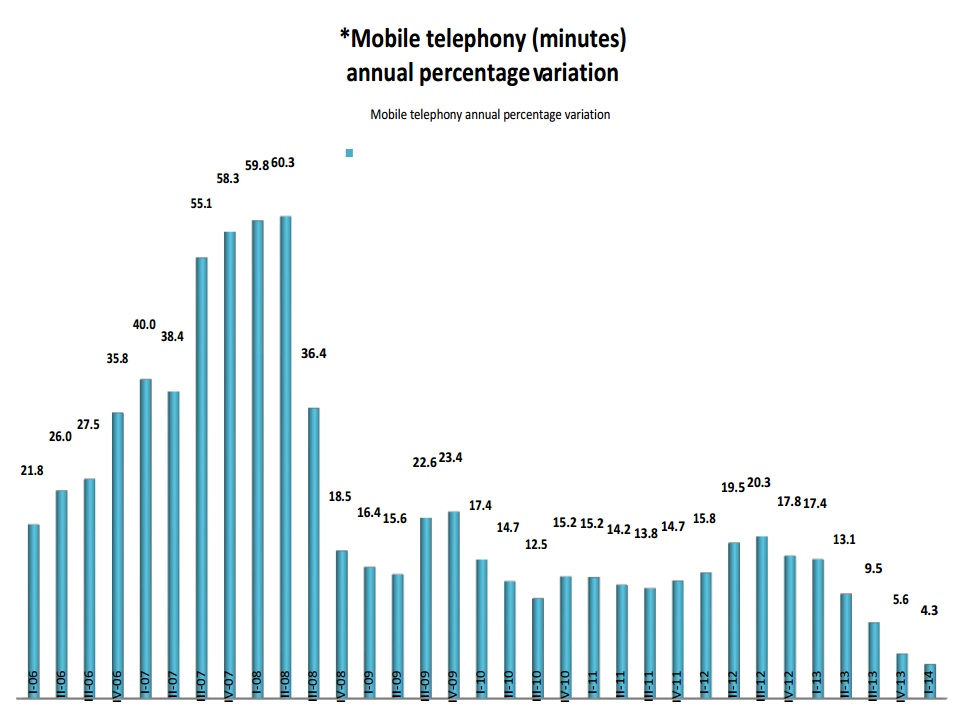
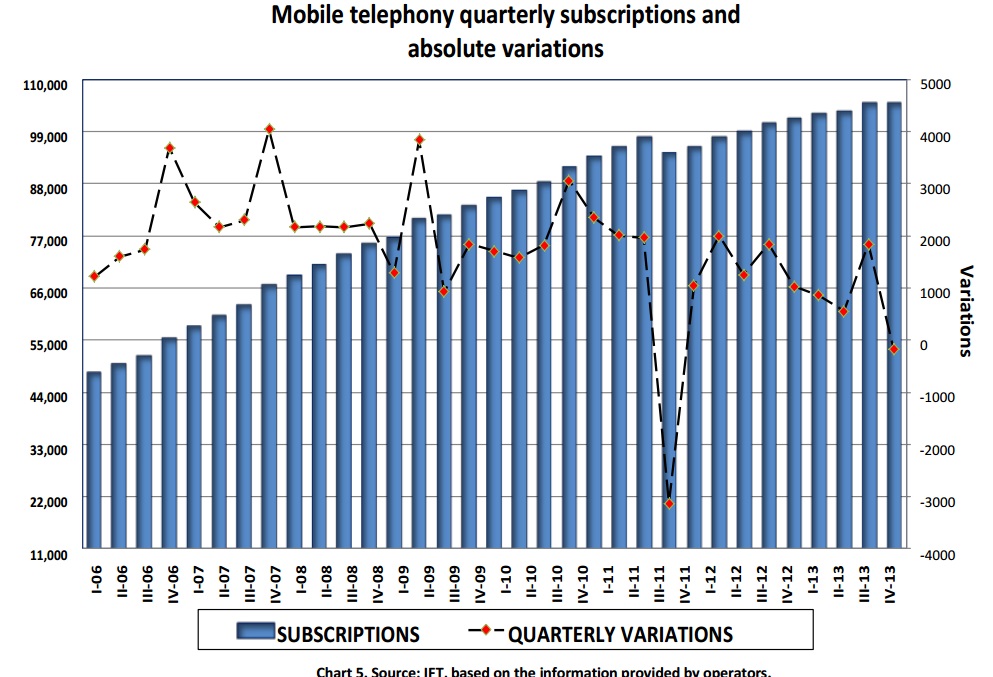
Mobile telephony recorded a 4.3% increase in traffic minutes run by the network during the first quarter of 2014. Three million subscribers were added during the quarter, compared to the same period the previous year, representing a 3.03% increase. The total subscription base is 105 million.
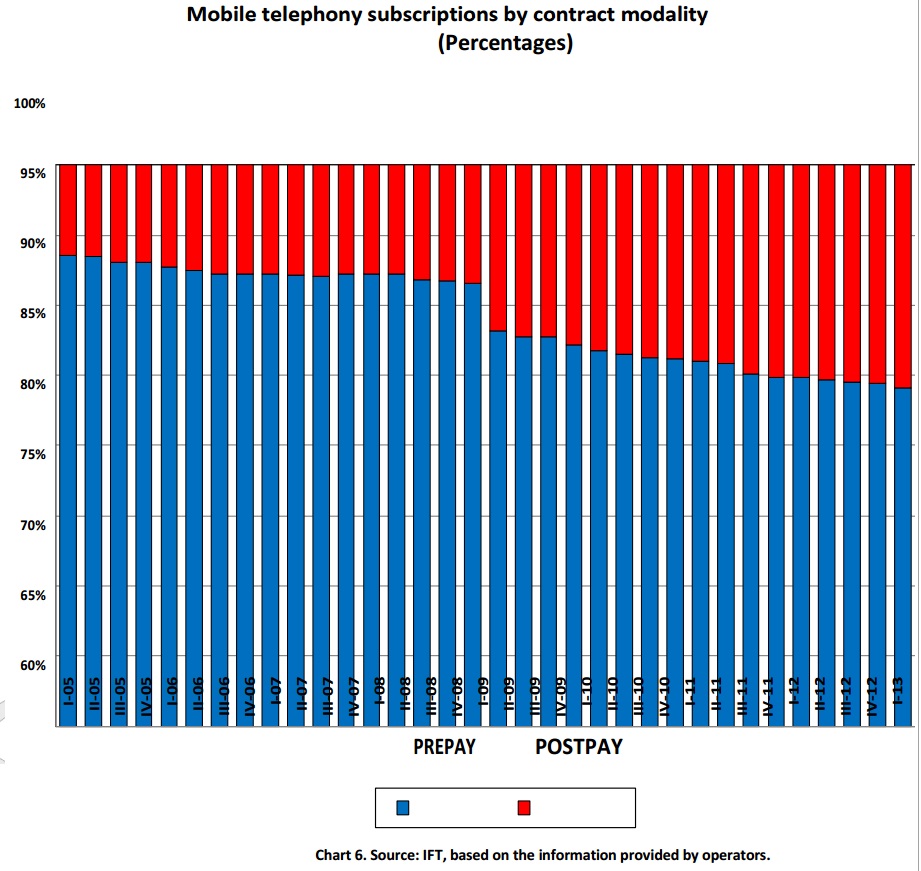
Regarding the market composition by type of subscription, by the end of the first quarter in 2014 there were 16 million post-pay users, representing 15.2% of the total market. While prepay modality recorded 88.8 million subscriptions, a 3.4% growth compared to the same period in 2013, and 84.7% of the total market.
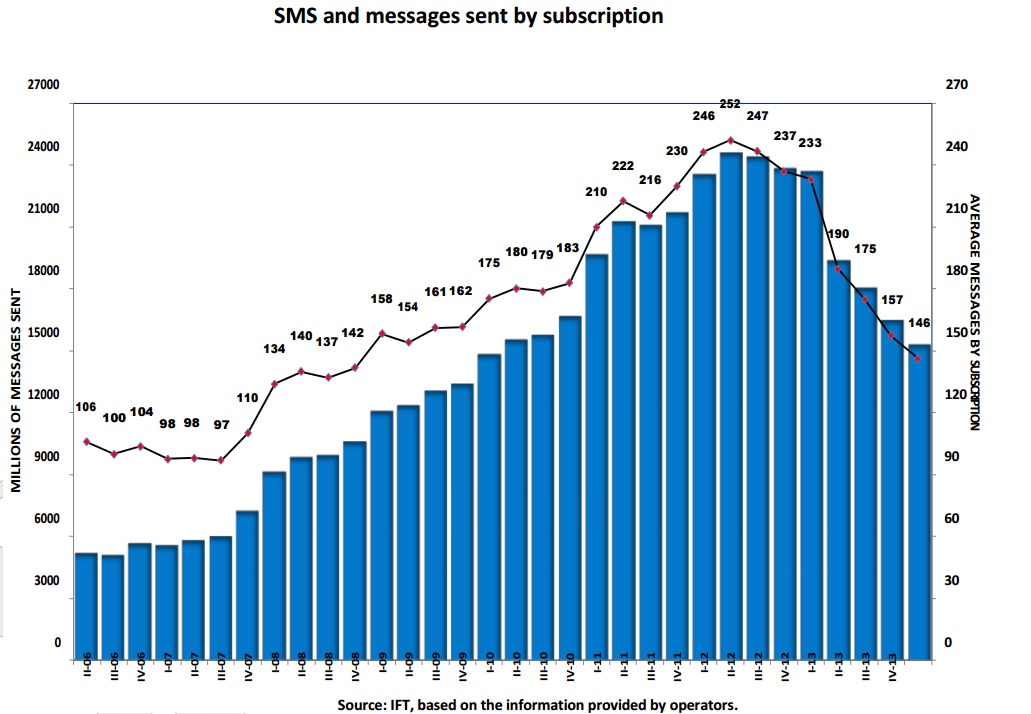
Messages sent (SMS) through mobile telephony recorded a 35.3% decease, compared to the first quarter in 2013, which equals an average of 144 messages sent by subscription during that period, the lowest figure recorded since the second quarter of 2009, reaching a maximum historical record of 252 SMS during the same period in 2012. This downward trend could be due to the migration of users to data-connectivity communication services (for example: Whatsapp, Skype, Messenger, Line, and Telegram, among others).
National Long Distance
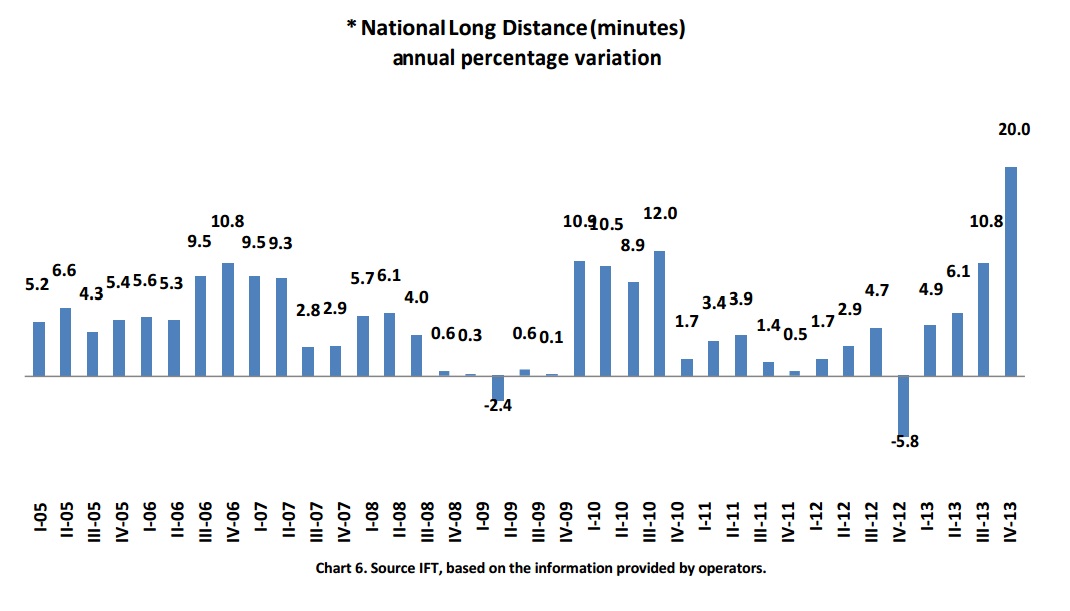
During the quarter reported, the traffic measured in minutes grew 20% compared to the same quarter the previous year.
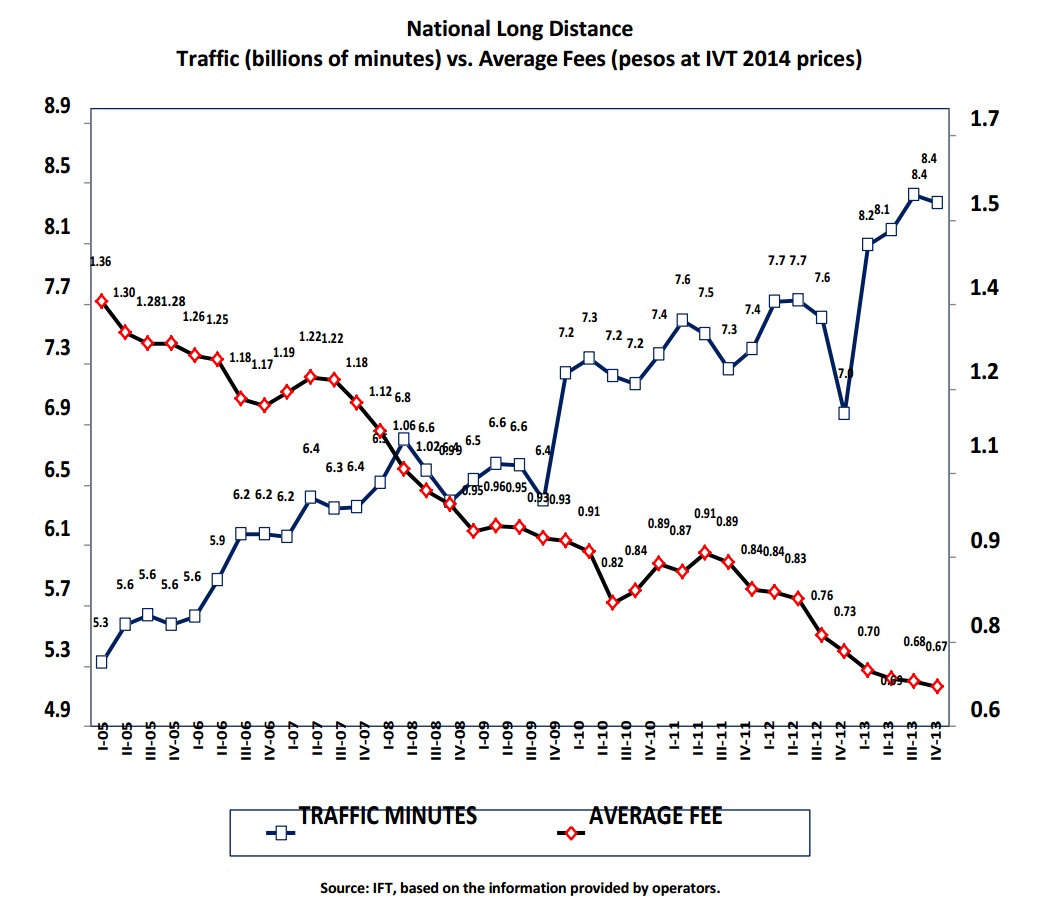
The national long distance average fee recorded was 0.67 pesos per minute.
International Long Distance
In the referenced quarter, the incoming international long distance traffic minutes increased 4% compared to the third quarter in 2013.
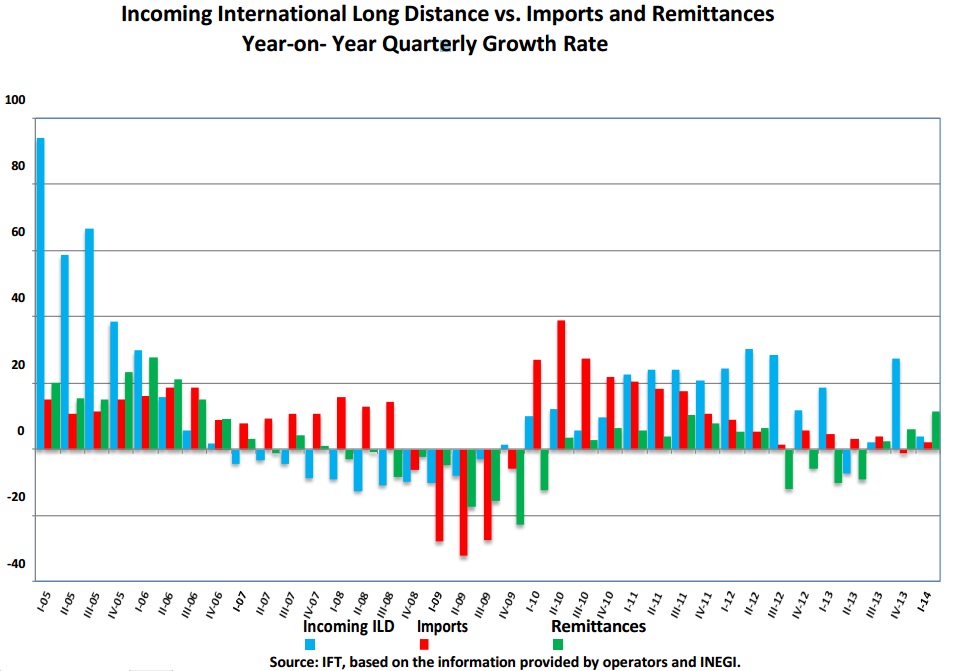
The outgoing international long distance traffic minutes recorded a 15% growth during the quarter reported, compared to the same period the previous year.

Trunking
During the last quarter of 2014, the number of users in this segment decreased 53.8% compared to the same period in 2013, which was the lowest rate reported since its behavior started to be measured.
The users of trunking services are migrating to the latest mobile technology services, recording 1.78 million users by the end of the first quarter in 2014.

Satellite Supply
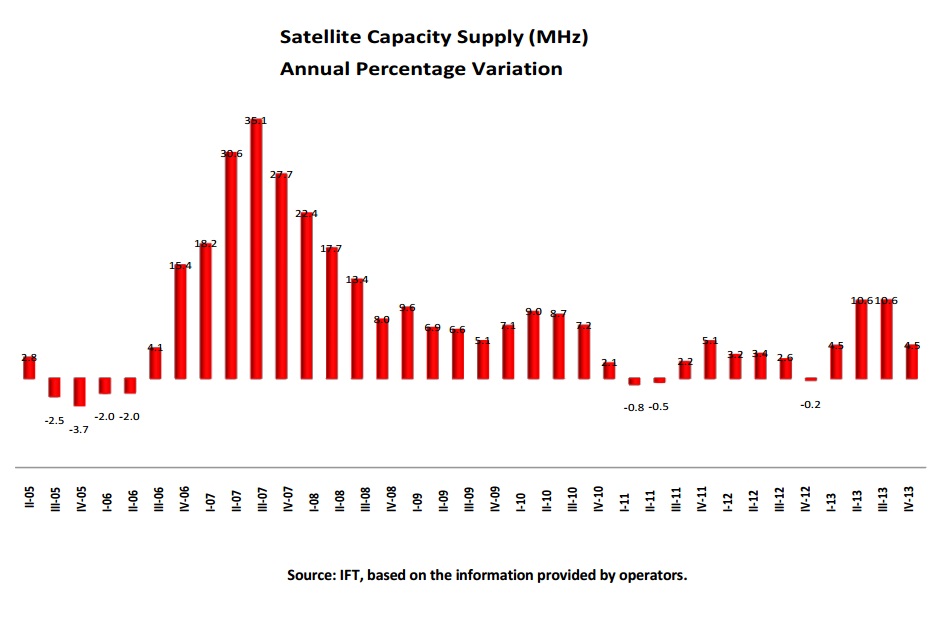
This segment recorded an annual increase of 4.5% during the first quarter in 2014. Megahertz (MHz) is the unit used to measure satellite capacity supply.
Local Telephone Fixed Line
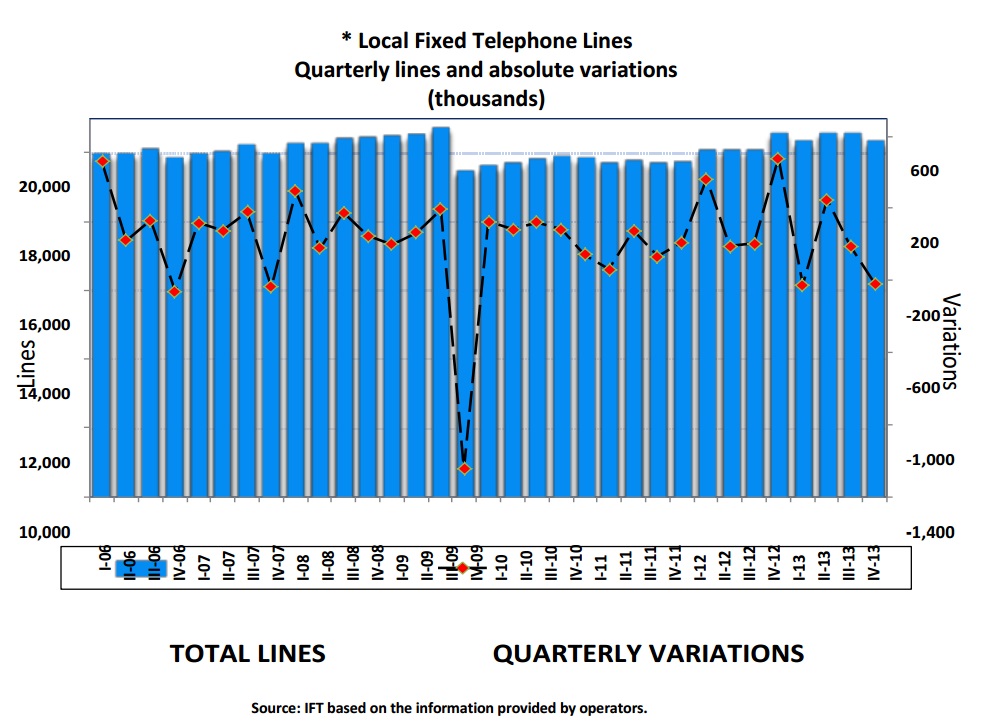
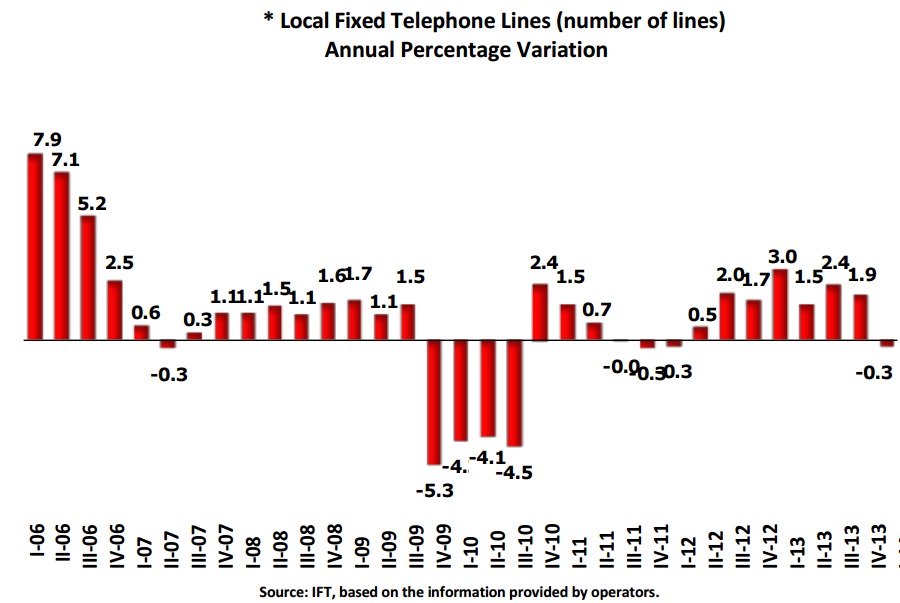
By the end of 2014 first quarter, the total number of fixed telephone line subscriptions was 20.4 million, which represented 200 thousand lines more than those recorded during the same quarter in 2013.
Fees Evolution
The expansion of Internet services, lower Internet access fees and competition in telecomm markets forced concessionaires to offer packages and promotions with increasingly attractive fees; therefore, fees tend to decrease in nominal and real terms, allowing an increasing number of inhabitants to have access to these services.

According to the information provided by the National Institute of Statistics and Geography (Instituto Nacional de Estadística y Geografía, INEGI), telecomm services costs, according to the sub-indexes of the National Index of Consumer Prices (INPC), showed a significant decrease during the first quarter in 2014.
During the quarter reported, the Sub-Index of telephone services fees decreased 4.6%, compared to the same period in 2013, including a 3.8% decrease of local fixed services, 3.0% reductions in national long distance and international long distance services, and a 5.4% decrease in mobile telephony services.
As part of the Sub-Index of other recreational services estimated by INEGI, there are actual reductions of 2.2% and 4.3% in pay TV and Internet services, respectively, compared to the same period in 2013.
It is important to highlight that the measurement of telecomm services fees made by INEGI is part of INPC's objectives, which include measuring the evolution, in time, of the general-cost of goods and services consumed in urban households in the country. In this sense, the representativeness of their considerations focuses on creating a set of goods and services to properly reflect household consumer patterns.[1]
[1] A broader explanation can be found in the methodological documents of INEGI at: http://www.inegi.org.mx/est/contenidos/proyectos/inp/Default.aspx.