



Ver lista del 18 de junio de 2015
Documentos para descargar
Temas relacionados
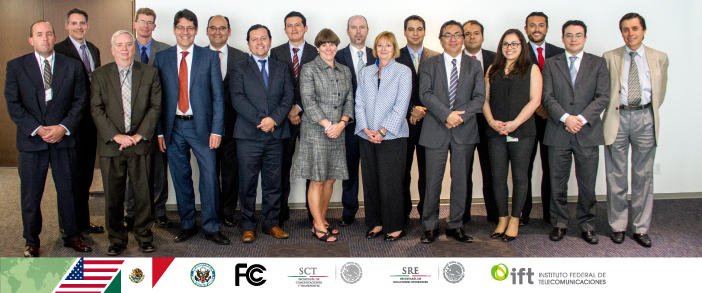
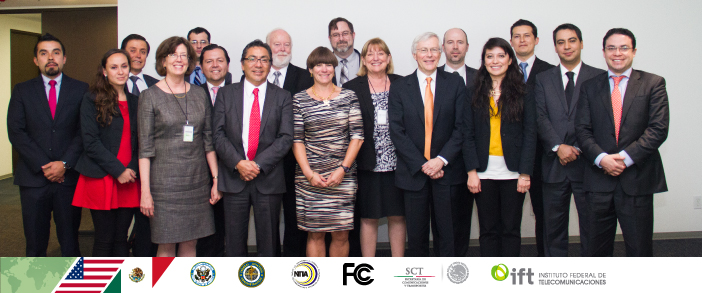
Mexico and the United States of America celebrate the bilateral meetings to discuss various issues related to the use of spectrum in the common border (Press Release 43/2015)
Mexico and the United States of America celebrate the bilateral meetings to discuss various issues related to the use of spectrum in the common border
- Officials from both countries give continuity to the work of coordinating spectrum use in the common border
- Mexico and the United States cooperate on issues of common interest within the framework of the preparation for the 2015 World Radiocommunication Conference
In order to further strengthen bilateral ties between Mexico and the United States in the field of telecommunications and broadcasting, officials from both countries met to discuss issues of common interest and develop action plans to achieve their common objectives.
On June 8th, the two delegations discussed issues concerning to the use of radio spectrum in the border between both countries for radiocommunication systems operating in the frequency bands: 220-222 MHz, 406.1-420 MHz, 600 MHz, 698-806 MHz , 806-824 / 851-869 MHz, 896-901 / 935-940 MHz, 2500-2686 MHz, 3550-3650 MHz, and 5.9 GHz, as well as the ones known as PCS and AWS. The progresses reached are an example of binational coordination to find solutions to the challenges that arise in the operation of telecommunications services and broadcasting along the common border.
Moreover, on June 9th the representatives of the two countries exchanged information about their positions on the various points on the agenda of the 2015 World Radiocommunication Conference of the International Telecommunication Union, a forum in which it will be reviewed and will amend the Radio Regulations, which is the treaty by which the international allocation of radio spectrum is governed.
As a result of this dialogue, overlapping interests were found in the spectrum identification for International Mobile Telecommunication Systems (IMT), aeronautical services, satellite fixed, and about regulatory issues relating to the use and exploitation of frequency bands and associated orbital positions.
On the part of Mexico, officials from the Ministry of Foreign Affairs, the Ministry of Communications and Transport and the IFT were attending; the United States was attended by officials from the State Department, the National Telecommunications and Information Administration (NTIA), the Federal Communications Commission (FCC) and Federal Aviation Administration (FAA).
These activities contribute to achieve the objectives of the Institute, particularly for regulate and monitor effectively and timely the use and exploitation of radio spectrum.
Documentos para descargar
Temas relacionados
X Sesión Ordinaria del Pleno 12 de junio de 2015
Acuerdo
P/IFT/120615/152
Descripción
Acuerdo mediante el cual el Pleno del Instituto Federal de Telecomunicaciones aprueba modificar las Reglas de Portabilidad Numérica, publicadas en el Diario Oficial de la Federación el 12 de noviembre de 2014.Sentido de votaciones
Diferenciado
A favor de la fracción XXVI de la Regla 2 y sus partes relacionadas
A favor de la fracción XXVI de la Regla 2 y sus partes relacionadas
A favor de la fracción XXVI de la Regla 2 y sus partes relacionadas
A favor de la fracción XXVI de la Regla 2 y sus partes relacionadas
En contra de la fracción XXVI de la Regla 2 y sus partes relacionadas
A favor de la fracción XXVI de la Regla 2 y sus partes relacionadas
A favor de la fracción XXVI de la Regla 2 y sus partes relacionadas
Acuerdo
P/IFT/120615/153
Descripción
Acuerdo mediante el cual el Pleno del Instituto Federal de Telecomunicaciones aprueba y emite el “Formato para presentar por parte de los concesionarios en materia de telecomunicaciones y radiodifusión la estructura accionaria o de partes sociales, en cumplimiento a lo establecido en el artículo 112 de la Ley Federal de Telecomunicaciones y Radiodifusión”.Sentido de votaciones
A favor
Acuerdo
P/IFT/120615/154
Descripción
Acuerdo mediante el cual el Pleno del Instituto Federal de Telecomunicaciones aprueba someter a consulta pública el “Anteproyecto de Acuerdo mediante el cual se establecen los lineamientos que fijan los índices y parámetros de calidad a que deberán sujetarse los prestadores del servicio móvil y se abroga el Plan Técnico Fundamental de calidad del servicio local móvil publicado en el Diario Oficial de la Federación el 30 de agosto de 2011”.Sentido de votaciones
A favor
Acuerdo
P/IFT/120615/155
Descripción
Acuerdo por el que se modifica el diverso mediante el cual el Pleno del Instituto Federal de Telecomunicaciones aprueba su Calendario anual de sesiones ordinarias y el Calendario anual de labores para el año 2015 y principios de 2016.Sentido de votaciones
A favor
Temas relacionados
IFT publishes the Comparable Information of Mobile Phone Plans and Rates Report (Press Release 42/2015)
IFT publishes the Comparable Information of Mobile Phone Plans and Rates Report
- In addition, it offers mobile phone users an online tool that enables the comparison exercises quickly and easily between the main features of each mobile plan
The Federal Telecommunications Institute (Instituto Federal de Telecomunicaciones, IFT) prepared the Comparable information of mobile phone plans and rates report, which contains the main findings from the analysis of the plans and rates offered by mobile phone concessionaires until May 31st of 2015.
In post-pay modality the price or monthly rent, the number of short messages (SMS) and voice minutes and data included in each plan were analyzed. In the case of prepayment, the variables were the price per minute, price per SMS and the price per megabyte (MB).
These are some of the most important findings:
- Of the fourteen schemes identified in prepaid offer, in only three of them the user can access to lower rates for voice minutes when increasing the amount of recharge made in a period.
- Of the fourteen schemes identified in prepaid offer, in only two of them the user receives gift balances, reducing unit prices for voice minutes, SMS and MB depending on charging higher volumes.
- In prepaid mode offer, three concessionaires that offer more of a prepayment scheme and they determine in which prepayment scheme starts the new user were identified.
- In greater than or equal to 100 pesos reloads the cost per minute of voice may decrease between 41% and 50% in comparison with reloads under 100 pesos.
- In the postpaid plans, the analyzed offer shows that the user can purchase the plan with or without terminal equipment. When a plan with a terminal equipment is hired, the monthly fees increase and / or in some cases, the equipment charge may be discounted for early payment or direct payments on a credit card.
- In the postpaid plans, elements having a higher variation in the same price range are the voice minutes and the MB included. Meanwhile, in the same price range SMS included in the plans do not present a significant variation.
- In the postpaid modality, two concessionaires analyzed the effect persists club, moreover a concessionaire in all its plans offer voice minutes and unlimited SMS indiscriminately and finally, one offered in most of their plans, toll free numbers for the first 5 minutes or unlimited SMS sending.
- The concessionaires offer additional options to the users in some cases called "additional packages" in which a user may purchase for an additional fee and a given period, more voice minutes, SMS and / or data.
In addition to the report, the IFT designed a feedback mechanism for users through an online tool in which you can view and compare in detail, quickly and easily, features such as price or monthly rent, included minutes, SMS, MB, restrictions and additional options for postpaid and prepaid plans, this in order that the mobile phone users will have enough information when deciding about hiring a service.
The online tool of the information analyzed in the report and is constantly updated and improved, so a brief satisfaction survey is included and will help the IFT in perfecting this.
Derived from the integration of the report and according to the analysis by the IFT, the institutions that make available to users the comparable information of rates and plans, directly help them to make better informed decisions, which triggers a virtuous cycle information for users.
The presentation of the data contained in the Report as well as the tool, is strictly for information purposes and may be consulted on the site www.ift.org.mx in the section "Usuarios y audiencias" in accordance with the policies of open data.
The IFT will publish different reports with comparable information which will allow users to identify useful information in a timely manner and help them to recognize the main changes in the rates and plans offered by operators over time.
Documentos para descargar
Temas relacionados
Entrevista a la Titular de la Unidad de Medios y Contenidos Audiovisuales del IFT, María Lizarraga en Uniradio Tijuana, sobre la transición a TDT
Entrevista a la Titular de la Unidad de Medios y Contenidos Audiovisuales del IFT, María Lizarraga en Uniradio Tijuana, sobre la transición a TDT
Documentos para descargar
Escuchar entrevista
Temas relacionados
Windows es accesible
1. Para activar los elementos de accesibilidad, debemos combinar la tecla Windows y la letra U y a continuación te mandará a centro de accesibilidad.
2. Una vez en centro de accesibilidad, podrás desplegar una serie de botones de configuración y vínculos informativos por medio de la tecla tabulador, para configurar los elementos de accesibilidad, pulsando la tecla enter para entrar a los elementos deseados y podrás salir de ellos con la combinación de teclas ALT + F4, de acuerdo con las necesidades específicas del usuario.
3. Entre las opciones que podrás encontrar son:
- Botón iniciar lupa: Ésta opción aumentará una parte de la pantalla
- Botón iniciar narrador: Automáticamente comenzará una voz a describir el texto de la pantalla.
- Botón iniciar teclado en pantalla: Bloquea el uso del teclado, permitiendo que por medio del mouse u otros dispositivos se puedan ejecutar todas las funciones de la máquina.
- Botón configurar contraste alto: Aumenta el contraste de color buscando facilitar la lectura de objetos.
- Vínculo usar texto o alternativas visuales para los sonidos
- Vínculo facilitar el uso del equipo.
- Vínculo facilitar el uso del mouse.
- Vínculo facilitar el uso del teclado.
4. Es importante señalar que al seleccionar cualquiera de las opciones, podrás ajustarla apoyándote de las teclas tabulador o flechas de navegación para configurar la función de acuerdo a tu necesidad en específico, como tamaño y brillo de la letra, velocidad y tono de la voz, entre otras.
5. Asimismo, podrás configurar si así lo deseas, el lector de pantalla, para que cada vez que enciendas la máquina, éste inicie al combinar las teclas Windows + Enter.
6. Finalmente, la eficacia de ésta herramienta sólo se podrá evaluar por medio de su uso constante y con ello poder contar con versiones que cumplan con la satisfacción de todas las necesidades de accesibilidad, es por lo que te invitamos a explorarlos y te familiarices con su uso.
# SoyUsuario
la información que necesitas para hacer valer tus derechos.
Cualquier duda o aclaración ¡llámanos! al 01800 2000 120.
Temas relacionados
Datos revelantes sobre la discapacidad
- Según cifras de la Unión Internacional de Telecomunicaciones, 15 % de la población mundial vive con una discapacidad, esto representa alrededor de 1 billón de personas en todo el mundo.
- Según cifras del INEGI, en México hubo 5 millones, 739 mil 270 personas con algún tipo de discapacidad en el 2010, lo que representó el 5.1% de la población total.
- Las tecnologías de la información y de la comunicación (teléfonos móviles, satélites o Internet) son herramientas que permiten ampliar el acceso a los servicios públicos esenciales y promueven la inclusión digital.
- La Convención Internacional sobre los Derechos de las Personas con Discapacidad exige la accesibilidad de las tecnologías de la información y la comunicación (TIC) en todos los estados que la forman, incluido México.
- La Ley Federal de Telecomunicaciones y Radiodifusión, tiene como objetivo establecer y salvaguardar los derechos de los usuarios y las audiencias con discapacidad, con el objeto de que exista una igualdad real de oportunidades.
- El Instituto Federal de Telecomunicaciones es el órgano encargado de promover que los usuarios con discapacidad tengan acceso a los servicios de telecomunicaciones en igualdad de condiciones con el resto de la población.
# SoyUsuario
Cualquier duda o aclaración ¡llámanos! al 01800 2000 120.
Temas relacionados
Celebración Aniversario La Entrevista con Sarmiento
Tema o Asunto a Tratar
Celebración Decimoctavo Aniversario La Entrevista con Sarmiento.
Breve descripción de la actividad
Celebración Aniversario La Entrevista con Sarmiento.
Ana Elisa Valentina Artigas Rovira, Gerente de Logística y Relaciones Públicas
Representantes de la Industria de las telecomunicaciones y radiodifusión.
Prensa.
Ver lista del 17 de junio de 2015
Documentos para descargar
Temas relacionados
Lista de asuntos para sesión del Pleno
Ver asuntos para sesión del Pleno
Documentos para descargar
Temas relacionados
Col. Nochebuena,