



El Pleno del IFT aprueba el Programa Anual de Trabajo 2015 (Comunicado 05/2015)
El Pleno del IFT aprueba el Programa Anual de Trabajo 2015
- La agenda regulatoria incluye 93 proyectos que forman parte de una estrategia integral que permite regular efectivamente y promover la competencia en los sectores de las telecomunicaciones y la radiodifusión, en beneficio de los usuarios y las audiencias
- Destaca la realización de estudios e investigaciones para atender los cambios tecnológicos y de mercado, a través de una visión de prospectiva regulatoria
- Se aprobó el Informe Trimestral de Actividades correspondiente a octubre-diciembre de 2014
El Pleno del Instituto Federal de Telecomunicaciones (IFT) aprobó en sesión extraordinaria el Programa Anual de Trabajo 2015, en el cual se incluyen las acciones y proyectos de política regulatoria que este órgano regulador considera desarrollar durante el presente año.
En este programa de trabajo se contempla el desarrollo de los proyectos que dan seguimiento a la política regulatoria implementada en 2014, el avance de los temas en proceso, así como nuevos proyectos y la realización de estudios e investigaciones en materia de telecomunicaciones, radiodifusión y competencia económica para atender los cambios tecnológicos y de mercado, a través de una visión de prospectiva regulatoria.
En total son 93 proyectos de la agenda regulatoria y 5 investigaciones. De esta forma, 48% corresponden a los proyectos que darán continuidad a la política regulatoria 2014, 46% son parte de los temas estratégicos 2015 y 5% son estudios e investigaciones para la prospectiva regulatoria.
Los proyectos y actividades que se describen en el documento, el cual ya está disponible para su consulta en la página del Instituto https://www.ift.org.mx/iftweb/wp-content/uploads/2015/01/PAT-2015-vF.pdf forman parte de una estrategia integral que permite regular efectivamente y promover la competencia en los sectores de las telecomunicaciones y radiodifusión, en beneficio de los usuarios y las audiencias. A su vez, se implementarán medidas que consoliden internamente al IFT, lo que redundará en mejorar su actuación, para dar mayor certidumbre a los entes regulados y, con lo anterior, generar precios asequibles, mejor calidad de los servicios y mayores opciones para los usuarios y las audiencias.
El foco de la agenda del presente año será avanzar en fomentar la convergencia y modernización tecnológica de los sectores de las telecomunicaciones y la radiodifusión, así como proteger los derechos e intereses de los usuarios y las audiencias.
Las estrategias que el IFT seguirá durante este año consistirán en:
- Fortalecimiento Institucional
- Políticas Regulatorias y de Competencia en los Sectores de las Telecomunicaciones y Radiodifusión
- Política del Espectro
- Despliegue y Modernización de la Infraestructura
- Derechos e Intereses de los Usuarios y las Audiencias
- Normatividad Específica de los Sectores Regulados
Asimismo, el Pleno del IFT aprobó su Informe Trimestral de Actividades correspondiente a octubre-diciembre de 2014.
Entre las acciones realizadas por este órgano regulador, durante el periodo referido, destaca la emisión de opinión favorable en materia de competencia económica respecto de las solicitudes presentadas por ocho interesados en participar en la licitación de concesiones de frecuencias para formar dos nuevas cadenas de televisión radiodifundida digital con cobertura nacional.
Asimismo, en diciembre pasado el Pleno del IFT aprobó el Programa Anual de Uso y Aprovechamiento de Bandas de Frecuencias 2015, mediante el cual se determinan las Bandas de Frecuencias de Espectro que serán objeto de licitación o que podrán asignarse directamente; así como el Acuerdo que determinó la terminación de transmisiones analógicas en las áreas de cobertura de las 14 estaciones de televisión radiodifundida que prestan servicio en Nuevo Laredo, Reynosa y Matamoros, en Tamaulipas.
Por otra parte, con el fin de transparentar y promover la participación ciudadana, el Pleno del Instituto aprobó que se sometiera a consulta pública el Anteproyecto de los Lineamientos de Colaboración en Materia de Seguridad y Justicia que deberán acatar los concesionarios y, en su caso, los autorizados, para que la colaboración con las autoridades competentes sea efectiva y oportuna; así como el Anteproyecto de las condiciones técnicas y operativas para la desagregación efectiva de la red local del Agente Económico Preponderante. Se aprobaron también las Reglas de Portabilidad Numérica, con las cuales se permite a los usuarios de telefonía fija y móvil que deseen cambiarse de proveedor conservando su mismo número telefónico que puedan hacerlo de manera más ágil y sencilla.
Durante el último trimestre de 2014, el IFT publicó en el Diario Oficial de la Federación las disposiciones que deberán cumplir los concesionarios que presten servicios públicos de telecomunicaciones para garantizar que los usuarios se beneficiarán con la eliminación de los cobros de la larga distancia nacional a partir del 1° de enero de 2015, así como la metodología para el cálculo de costos de interconexión; el sistema electrónico de solicitudes de interconexión y las tarifas de interconexión que estarán vigentes durante el presente año, además de las condiciones técnicas mínimas para la interconexión entre concesionarios que operen redes públicas de telecomunicaciones.
Por otra parte, el Pleno del Instituto resolvió en sesión extraordinaria cuatro desacuerdos de interconexión entre concesionarios de redes públicas de telecomunicaciones y concesionarios pertenecientes al Agente Económico Preponderante (AEP) en ese sector.
Dos de estas resoluciones se refieren a las condiciones de interconexión no convenidas entre Teléfonos de México, S.A.B de C.V (Telmex), por una parte, y Teléfonos de Noroeste, S.A. de C.V. (Telnor), por otra, con Mega Cable, S.A. de C.V. (Megacable). En ambos casos, el IFT estableció que en las tarifas por Servicios de Terminación Conmutada, deberán observar lo dispuesto por el artículo 131 de la Ley Federal de Telecomunicaciones y Radiodifusión.
Asimismo, las tarifas por terminación/originación de tráfico en tránsito hacia y desde una tercera red, serán las siguientes:
a) Para el 6 de abril de 2014 al 31 de diciembre de 2014, se deberá observar el Acuerdo de Tarifas asimétricas que cobrará el AEP.
b) Para el periodo comprendido del 1° de enero al 31 de diciembre de 2015, se deberá estar a lo dispuesto en las tarifas de interconexión aplicables al año 2015 aprobadas por el IFT en diciembre pasado.
El IFT acordó también, entre otras medidas, que Telmex y Telnor deberán otorgar a Megacable intercambio de tráfico mediante el protocolo de señalización SIP. Deberán también permitirle uso de un mismo enlace de interconexión para cursar distintos tipos de tráfico y entregarle elementos para la eficiente interconexión en plazos definidos.
Por otra parte, el Pleno del IFT resolvió las condiciones de interconexión no convenidas entre Radiomóvil Dipsa, S.A. de C.V. (Telcel) y Talktel, S.A. de C.V. Con base en ello, la primera deberá otorgar a la segunda intercambio de tráfico mediante el protocolo de señalización SIP y le permitirá el uso de un mismo enlace de interconexión para cursar distintos tipos de tráfico.
Documentos para descargar
Temas relacionados
El IFT da a conocer nuevos datos de banda ancha (Comunicado 13/2015)
El IFT da a conocer nuevos datos de banda ancha
- La base de suscripciones llegó a junio de 2014 a 47,284,849 lo que equivale a que casi 40 de cada 100 habitantes tenga acceso al servicio
- Nuevos esquemas de prepago que promueven el uso de redes sociales y mayor competencia en el segmento de prepago detonan el crecimiento
La base de suscriptores de banda ancha inalámbrica en el país ascendió a 47, 284, 849 en junio de 2014, con lo cual se alcanzó una penetración de 39.9 suscriptores por cada 100 habitantes con acceso a banda ancha inalámbrica, la cual incluye los servicios de satélite (.08%), fijo inalámbrico (1.11%), y banda ancha móvil (98.8%).
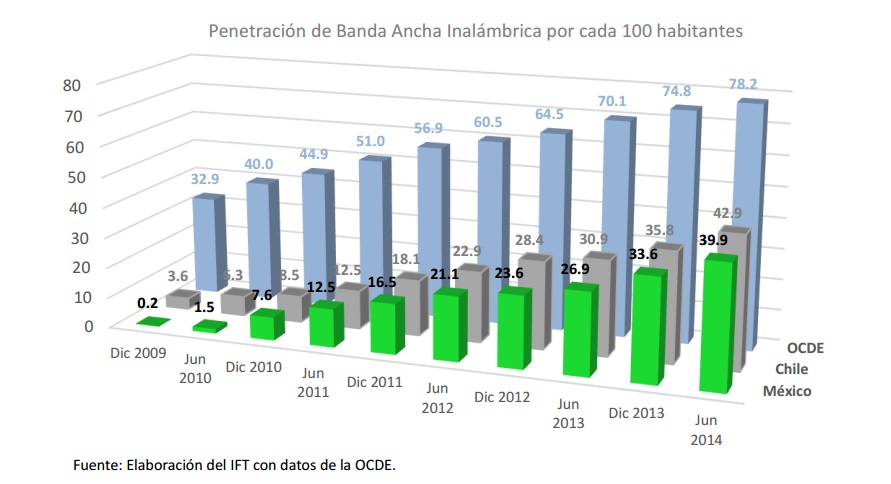
Este nivel de suscripciones se puede explicar en parte por la incursión de nuevos esquemas de prepago en el mercado móvil, que incorpora accesos o servicios, como son los de redes sociales que están al alcance de un gran volumen de suscriptores de prepago que existen en México, así como por la mayor competencia por obtener usuarios con contratos de pospago por parte de los operadores móviles. Con lo anterior, México avanza y se posiciona con niveles de penetración por arriba de Hungría, Turquía, Portugal y Grecia, y muy cercano a Chile.
De acuerdo con la definición de la Organización para la Cooperación y Desarrollo Económicos (OCDE), las suscripciones de banda ancha son aquellas que cuentan con una velocidad anunciada de 256 kbps o mayores. Las suscripciones deben permitir acceso a Internet vía http y debe ser usado para hacer una conexión de datos vía Protocolo de Internet (IP, por sus siglas en inglés) en sus tres meses anteriores.
Los mensajes de SMS y MMS no cuentan como una interconexión activa de Internet de banda ancha, incluso si estos son entregados vía IP. Este indicador está medido en número de suscripciones por cada 100 habitantes.
A su vez, la Ley Federal de Telecomunicaciones y Radiodifusión prevé que las mediciones de los sectores de telecomunicaciones y radiodifusión deberán apegarse a las metodologías reconocidas internacionalmente que permiten la medición del progreso y la comparación internacional, al mismo tiempo que otorgó mejores herramientas al regulador para obtener información de los concesionarios.
Con base en lo anterior, el IFT se apega a los estándares internacionales y utiliza variables acordes a las previstas por la Unión Internacional de Telecomunicaciones (UIT) y la OCDE, como por ejemplo las suscripciones con acceso a velocidades superiores a 256 kbps. Con este cambio metodológico se presentan los datos revisados desde 2010 para penetración de banda ancha inalámbrica móvil.
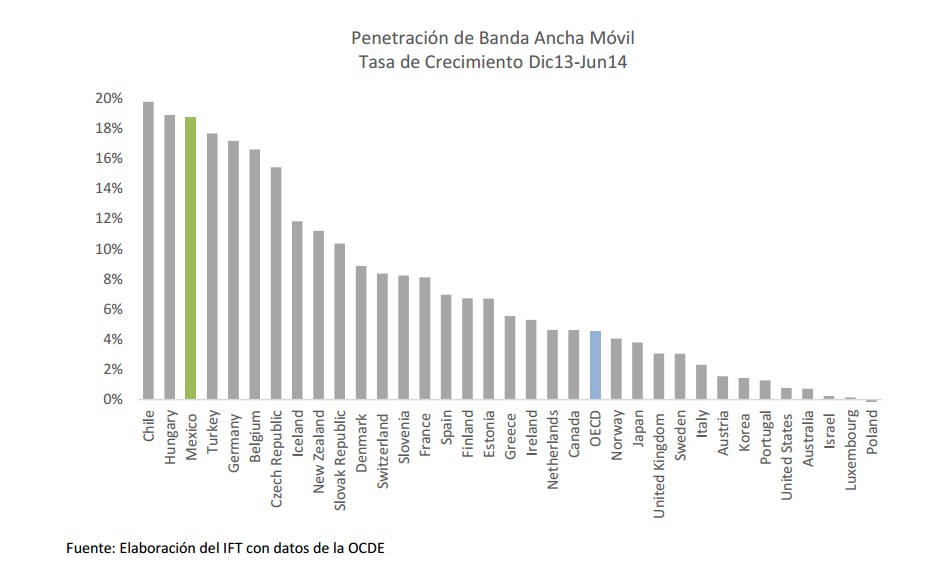
Por otra parte, el último reporte estadístico de la OCDE sobre banda ancha muestra que de diciembre de 2013 a junio de 2014, se registró un aumento de 18.8% de penetración de banda ancha inalámbrica móvil en nuestro país, con lo cual México ocupa el tercer lugar entre los países de la OCDE que mayor crecimiento porcentual reportan en la penetración de este mercado.
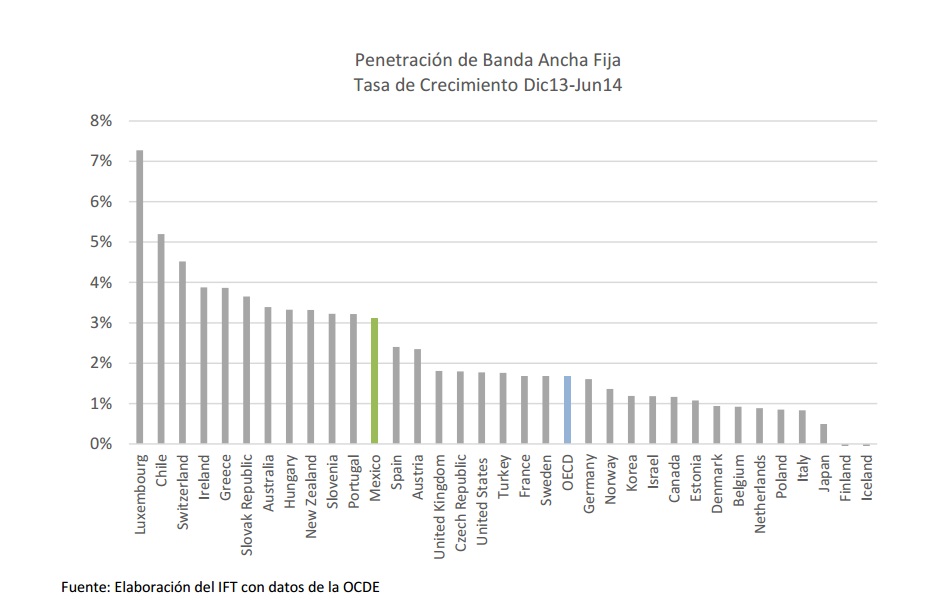
Para el caso de banda ancha fija, entre diciembre de 2013 y junio de 2014, se observa un crecimiento en la penetración para este servicio de 3.1%, lo que ubica a México en el lugar número 12 de los países que presentan mayor crecimiento porcentual en la penetración, por arriba del promedio de la OCDE.
Durante el primer trimestre de 2015, el IFT publicará el Informe Estadístico correspondiente al tercer trimestre de 2014, en el que se incluirán los principales indicadores del sector telecomunicaciones, cuya metodología de medición será acorde con las mejores prácticas internacionales y con los lineamientos utilizados por la UIT y la OCDE. Dentro de los principales cambios se ofrecerá la información con mayor nivel de desagregación, además de que se reflejarán las cifras recabadas directamente de los operadores, evitando en la medida de lo posible los datos preliminares o estimados.
Documentos para descargar
Temas relacionados
Entrevista a la Comisionada Adriana Labardini con Javier Solórzano en Ultra Noticias sobre decisión de Grupo Radio Centro
Entrevista a la Comisionada Adriana Labardini con Javier Solórzano en Ultra Noticias sobre decisión de Grupo Radio Centro
The Plenary of IFT declares void the tender process of a national broadcast television network (Press Release 27/2015)
The Plenary of IFT declares void the tender process of a national broadcast television network
- At breached the payment of the consideration offered, the Federal Telecommunications Institute decided to disqualify Grupo Radio Centro from the process and instruct the implementation of its security bid
At an extraordinary meeting held yesterday, the Plenary of the Federal Telecommunications Institute (Instituto Federal de Telecomunicaciones, IFT) decided to disqualify Grupo Radio Centro, S.A.B. de C.V. and annul the decision that declares it as the successful bidder in the bidding procedure No. IFT-1, in order to form a digital television network with national coverage in the country.
The Radio Spectrum Unit of the Institute confirmed that the receipts that credited the payment offered by Grupo Radio Centro for consideration or for the rights and land use within the period prescribed in the bidding, which ended on last April 10th, were not received.
Therefore, in accordance with the provisions of these bases in case of default by the participants, the Plenary decided to run the bid bond for $ 415,000,000 (four hundred fifteen million pesos) issued by the company, under the terms established in the bases.
Thus, the Plenary of the Institute declared void the IFT-1 tender only in respect of the national network of 123 channels of digital broadcast television of which had been declared winner participant Grupo Radio Centro.
As reported timely, the Institute will analyze the actions to be taken with respect to the frequency bands that became available.
Documentos para descargar
Temas relacionados
The Plenary of IFT approves the minimum technical conditions and interconnection rates in force for 2015 (Press Release 76/2014)
The Plenary of IFT approves the minimum technical conditions and interconnection rates in force for 2015
• Met in a timely manner the mandated by Law that establishes the obligation to issue these provisions in the fourth quarter
• The minimum technical conditions provide a framework under which interconnection services will be provided
In compliance with Article 137 of the Federal Telecommunications and Broadcasting Law, the Federal Telecommunications Institute (Instituto Federal de Telecomunicaciones, IFT) aproved the minimum technical conditions and fees resulting from the cost methodologies issued by the regulatory body, which will be force during 2015.
On December 18, 2014, the Institute published in the Official Gazette of the Federation (Diario Oficial de la Federación, DOF) the Agreement by which the Plenary of IFT issued the methodology for calculating interconnection costs in accordance with the Federal Law on Telecommunications and Broadcasting so it proceeded to elaborate models, one for fixed services and another one for mobile services, and calculate rates.
These models considered an efficient operator with a network deployment that, in the case of the Fixed Pattern comprises a national scope, and a covering of 90% of the population in the Mobile Model. It also took into account a market share of 16% for alternative mobile operator and 36% for alternative fixed operator, using modern technology efficiently.
It is important to note that the models were calibrated with data from the network of existing concessionaires, including all services provided by operators in Mexico and were developed with a focus on Pure Incremental Costs of Long Term.
It is noteworthy to mention that, according to the provisions of the methodology for calculating interconnection costs, a factor of gradualism was applied in order to allow dealers to public telecommunications networks to adapt their business plans to the new regulatory environment.
Thus, for fixed or mobile local services other than the Preponderant Economic Agent, rates are as follows:
• For termination services Local Service Mobile users under the "calling party pays" is $ 0.2505 pesos M.N. per interconnection minute.
• For termination services (SMS) to mobile users is $ 0.0261 pesos M.N. per message.
• For local termination services in fixed service users is $ 0.004179 pesos M.N. per interconnection minute.
For services rendered by the Preponderant Economic Agent, the applicable rates are:
• For local origination services in fixed service users is $ 0.005162 pesos M.N. per interconnection minute.
• For transit services is $ 0.006246 pesos M.N. per minute.
Also, the Plenary of the Institute approved the Agreement by which it is established the minimum technical conditions for interconnection between concessionaires operating public telecommunications networks, which is published in the following days in the Official Gazette of the Federation (Diario Oficial de la Federación, DOF) and is valid throughout the following calendar year.
The Agreement issued incorporates comments received during the public consultation process that was subject to the corresponding draft from November 21th to December 4th of 2014, which allowed clarifications and improvements to this regulatory instrument.
The minimum technical conditions provide a framework under which interconnection services are provided and consider the following:
• Technical aspects that allow the interconnection of public telecommunications networks considering technological developments and current conditions of public telecommunications networks.
• The technical information necessary for interconnection points that dealers must provide for the interconnection of their networks.
• The concessionaires will conduct the traffic within its network to interconnection points where traffic exchange is performed. Such traffic may be of any origin or destination within the country, as well as any type (local, transit, mobile, fixed).
• To ensure continuity in the provision of interconnection services redundancy schemes are established.
• Methods, parameters and required fields are indicated to perform the interconnection over IP technology, ensuring the provision of voice service with the same quality with which the service is offered currently.
• Technical conditions for collocation service are defined by establishing three types of physical space for it, which promotes efficiency in service delivery.
• The basis for cross interconnection between concessionaires with presence in one interconnection point are established.
Documentos para descargar
Temas relacionados
XXII Sesión Extraordinaria del Pleno 13 de abril 2015
Acuerdo
P/IFT/EXT/130415/82
Descripción
Acuerdo mediante el cual el Pleno del Instituto Federal de Telecomunicaciones descalifica a Grupo Radio Centro, S.A.B. de C.V. del procedimiento de Licitación pública para concesionar el uso, aprovechamiento y explotación comercial de canales de transmisión para la prestación del servicio público de televisión radiodifundida digital, a efecto de formar dos cadenas nacionales en los Estados Unidos Mexicanos (Licitación No. IFT-1); deja sin efectos el fallo mediante el cual Grupo Radio Centro, S.A.B. de C.V. fue declarado participante ganador; instruye la ejecución de la garantía de seriedad otorgada por Grupo Radio Centro, S.A.B. de C.V.; y declara desierto el procedimiento de Licitación No. IFT-1 respecto de la cadena nacional de 123 canales de televisión radiodifundida digital por la que se declaró participante ganador a Grupo Radio Centro, S.A.B. de C.V.Sentido de votaciones
A favor
Temas relacionados
The Plenary of IFT approves the 2015 Use and Exploitation of Bands Annual Program (Press Release 75/2014)
The Plenary of IFT approves the 2015 Use and Exploitation of Bands Annual Program
The Plenary of the Federal Telecommunications Institute (Instituto Federal de Telecomunicaciones, IFT) approved, in extraordinary session, the 2015 Use and Development of Frequency Bands Annual Program (Agenda 2015), which contains the frequencies and radio spectrum bands to be made available to interested parties for the provision of telecommunications and broadcasting services, through a bidding process or, if appropriate, by direct allocation next year.
Thus, the IFT implements, in a timely manner, as provided in Article 59 of the Federal Telecommunications and Broadcasting Law (Ley Federal de Telecomunicaciones y Radiodifusión, LFTR) which establishes the obligation to issue, no later than December 31 of each year, the program with the frequency bands of spectrum determined to be tendered or who may be allocated directly, and which must contain at least the services to be supplied, their category, use patterns and geographic coverage.
To prepare the 2015 Program, the Institute was based on the following criteria: promote the efficient use of radio spectrum, the benefit of the users, the development of competition and diversity and introduction of new telecommunications and broadcasting; promote the convergence of networks and services to achieve efficient use of infrastructure and innovation in application development and ensure the necessary spectrum for the purposes and functions of the Federal Executive.
In this sense, in telecommunications for commercial use, the 2015 Program provides:
a) The concessioning of 60 MHz of spectrum identified for International Mobile Telecommunications (IMT) service deployment, specifically in the segments of 1710-1725 / 2110-2125 MHz and 1755- 1770 / 2155-2170 MHz.
b) The concessioning of 10 MHz of spectrum in the lower UHF range, specifically in the 440-450 MHz segment for the provision of capacity for private radio systems.
The 2015 Program states that a decision on these tenders of commercial use must be within 2015. Also, for the first time specific bands for social services use in the telecommunications sector are determined. For this, is contemplated the concessioning of various portions of spectrum that are available within the segment known as the cellular band between 824-849 MHz and between 869-
894 MHz. For its use it is proposed that these portions of spectrum to concession for the provision of rural connectivity, which could meet the immediate needs to have basic telephone service in regions not served by existing concessionaires.
Regarding frequencies for telecommunications services for public use, the 2015 Program includes two frequency bands: 415-420 / 425-430 and 806-814 / 851-859. Those interested in obtaining a concession for public use to provide telecommunications services may submit the relevant applications for these and other bands during any working day of the year.
As for broadcasting, the 2015 Program includes the concessioning of 115 frequencies for radio broadcasting service in Frequency Modulation in different regions. Of these, 97 frequencies are for commercial use and 18 for social use, which is determined in response to expressions of interest, the economic capacity of the spaces and the available spectrum.
For broadcast television services no spectrum was considered for a concession in 2015, since they are currently ongoing procedures such as frequencies tendering to form at least two chains of digital broadcast television, the transition to Digital Terrestrial Television and the evaluation of the eventual clearance of 600 MHz band (TV channels 38 to 51).
Regarding the frequencies to grant rights for indigenous and social use, the IFT determined to reserve the frequencies contained between FM 106 and 108 MHz, which means, according to the provisions of the legal framework, 10% of the FM band; while that in the corresponding frequencies AM were reserved for his extended band from 1605-1705 kHz. For this type of concessioning is included in 2015 Program all the bands reserved and three terms are defined to present the corresponding applications: April, July and November 2015.
For concessions for public use in broadcasting applications submitted by the deadline set in the 2015 program itself, both stations AM, FM or TV are considered, the latter only in the range of 14 to 37 channels.
The Institute will establish coordination mechanisms with the various relevant bodies for the allocation of concessions for public use, to ensure the spectral requirements of the Federal Executive in terms of law and seek to meet those of other bodies to which awards may be intended for public use in terms of the LFTR.
Note that, once released the 2015 Program, a period of 30 working days is opened to allow interested parties to request the inclusion of frequency bands or additional geographic coverage or different from those mentioned in accordance with the provisions of 61 Article of Federal Telecommunications and Broadcasting Law. Once this period has elapsed, the IFT evaluate applications for inclusion received within thirty working days to, if necessary, to make the appropriate changes in the final program that will be applicable for 2015.
Thus, the IFT seeks to make available for 2015, various bands and frequency channels in suitable portions of spectrum for the provision of high impact for society, such as mobile broadband communications, rural telephony, radio and television, among others.
Documentos para descargar
Temas relacionados
The Plenary of IFT authorizes and conditions the Televisa output from Grupo Iusacell and subsequent sale of this company to AT&T (Press Release 74/2014)
The Plenary of IFT authorizes and conditions the Televisa output from Grupo Iusacell and subsequent sale of this company to AT&T
• Approves the final structural separation of Televisa and Salinas and the incursion of the US firm in Mexico
• If companies do not accept or comply with the conditions imposed, shall be deemed not approved for all legal purposes that may apply
• Resolved on Cablecom acquisition by Grupo Televisa
The Plenary of the Federal Telecommunications Institute (Instituto Federal de Telecomunicaciones, IFT) resolved to authorize two concentrations, subject to conditions, which will involve the definitive structural separation of Grupo Salinas and Grupo Televisa in the provision of telecommunications services, and the incursion of AT&T as a competitor in the provision of mobile telecommunications services in Mexico, respectively.
On December 12 of this year, the Plenary allows that the Salinas Group, that owns 50% shares of GSF Telecom Holdings (GSF), to buy to Grupo Televisa the remaining 50% stocks of this company which, through its subsidiaries, engages in the provision of fixed and mobile telecommunications.
Such approval is subject to conditions imposed by the Institute.
With this transaction, Grupo Televisa will no longer participate in the decision-making on business of fixed and mobile telecommunications that Grupo Salinas operates through GSF and its affiliates.
Moreover, on December 15th, 2014, the Plenary approved, subject to conditions, the acquisition by AT&T's mobile telecommunications business of Grupo Salinas, which is formed for assets and subsidiaries involved in the provision of telephony, messaging and mobile internet access, among which there are Iusacell and Unefon.
The concentrations to be held consecutively, are subject to the fulfillment of commitments and verification mechanisms to avoid as a result of the concentration is decreased, damage or process of free competition is prevented.
If companies do not accept the conditions imposed by this authority, or accept them but the breach, shall be considered as unauthorized for all legal purposes that may be required.
Once Grupo Salinas holds 100% of the shares of GSF, split the company into two businesses:
• The fixed telecommunications, which include Total Play; and
• The mobile telecommunications, which include Iusacell and Unefon
Grupo Salinas will retain control over the wireline business and sell the mobile business to AT&T. Thus, AT&T will enter the Mexican market as a provider of mobile telecommunications services. When ruling on the second concentration, the Plenary of the Institute took into consideration the relationship that AT&T had with America Movil (Telcel), leading operator of mobile telecommunications services in Mexico. Consequently, the conditions imposed on AT&T introduce measures to avoid risks to the process of competition in markets where these economic agents are involved.
As background of both concentrations is important to note that on December 9, 2014, the Plenary of IFT resolved a concentration which dates from 2011 and was analyzed by the former Federal Competition Commission (Comisión Federal de Competencia, CFC), which consisted on the acquisition by Grupo Televisa 49% representing stocks of the capital share of GSF, which were sold by Grupo Salinas.
The CFC initially did not authorize this concentration. However, the parties requested the authority to review its first decision and, in that process, submitted commitments based on which the CFC Plenary resolved to authorize the subject to conditions.
The consolidation was held in June 2012 and the parties subsequently promoted amparo trials against the decision of the CFC. They argued that during the first procedure, the CFC performed acts not provided for in the Federal Antitrust Law applicable and therefore improperly extended the deadline to rule on the concentration, so that the initial decision of the CFC issued outside the limit prescribed by law and operated the constructive approval for the benefit of the parties.
Subsequently, in November 2014, the Tenth Collegiate Court for Administrative Matters of the First Circuit issued a writ of execution in which he ordered the Institute, as the authority responsible substitute for extinct CFC, leaving subsistent resolutions issued earlier this concentration and issue one in which, evaluating the arguments of the parties, rule on whether operated or not constructive approval, regardless acts performed by the CFC that were not provided by applicable law.
In strict compliance with the order, on December 9, 2014, the Plenary of the Institute left without effect the resolutions issued by the CFC on the concentration and issued another in which it determined that the regulatory body ruled out the time that the law gave it, which operated the figure of constructive approval on concentration.
Televisa - Cablecom concentration
Moreover, on December 10 of 2014, the Plenary of IFT decided on the acquisition of Cablecom by Grupo Televisa, and determined that it does not have the effect of reducing, damaging or preventing free competition and competition in the sector.
On August 14 of 2014, Grupo Televisa reported a concentration through which it acquired Cablecom, a firm that provides fixed telecommunications services of voice, Internet and television networks, via a wired network; and requested to be processed under Ninth Transitional Article of the Federal Telecommunications and Broadcasting Law.
That provision states that as long as there Preponderant Economic Agents in the telecommunications and broadcasting sectors, other operators may carry concentrations without requiring prior authorization from the Institute. This procedure is temporary, it will only be in effect as long as there are Preponderant Economic Agents, and establishes an exception to the merger control provisions of Article 90 of the Economic Competition Federal Law.
While the notice procedure provided for in the first to fourth paragraphs of transitory article noted, entitles individuals the right to belong to an exception regime --for not requiring the prior approval of the Plenary of the Institute-- that the parties certify that the concentration will neither reduce, damage or prevent free competition and competition in the area of the sector concerned.
In this sense, on December 10 of 2014, the Plenary of IFT, by majority vote, determined that the concentration met the requirements set forth in subparagraphs and therefore does not have the effect of reducing, damage or impede the free competition and competition in the telecommunications sector.
In its resolution, the Plenary of the Institute identified that the concentration has positive effects on fixed telephony and internet access. In these, Grupo Televisa participates as a smaller player and announces investment to install and develop broadband networks capable of providing converged Internet, fixed telephony and television networks. The effects of the concentration were evaluated to identify their net effect on the telecommunications sector.
On the demand side, broadband networks provide a means for users to use multiple means of electronic communication; and enables the provision of a variety of end services through Internet, for example providing access to audiovisual content, information, education, cloud services or interactive games, among others.
However, the Plenary also identified that in the pay television service, the customer, Grupo Televisa accumulates the highest number of subscribers. Nevertheless, elements that can counteract this effect are also found, among them: the existence of pressure to compete in quality and price; improvements in the availability and quality of service of restricted television offering to end users; and the existence of a dynamic and converging environment in the supply of audiovisual content to end users.
Furthermore, in terms of the fifth paragraph of Ninth Transitional Article of the Federal Telecommunications and Broadcasting Law, the Institute through the Investigating Authority, has begun an investigation to determine whether this concentration confers, may confer or increase the substantial power in the field of "market" of the acquirer, Grupo Televisa, and if appropriate, impose the necessary measures to protect and promote free competition.
Documentos para descargar
Temas relacionados
Retransmisión de contenidos
Temas relacionados
Entrevista al Comisionado Presidente Gabriel Contreras con Maricarmen Cortés, José Yuste y Marco Mares en Alebrijes sobre la decisión de Grupo Radio Centro
Entrevista al Comisionado Presidente Gabriel Contreras con Maricarmen Cortés, José Yuste y Marco Mares en Alebrijes sobre la decisión de Grupo Radio Centro
Col. Nochebuena,